


Page 113 - Read Online
P. 113
Page 22 of 34                             Xi et al. Soft Sci 2023;3:26  https://dx.doi.org/10.20517/ss.2023.13


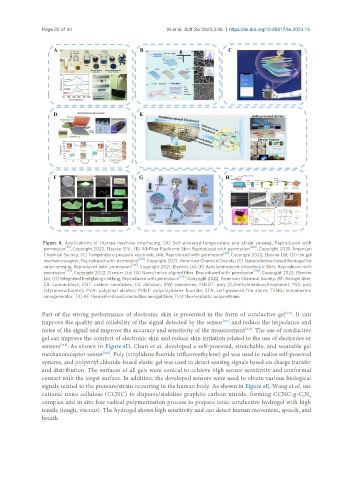
                Figure  8.  Applications  of  Human-machine  interfacing.  (A)  Self-powered  temperature  and  strain  sensing,  Reproduced  with
                       [33]                                                          [206]
                permission  , Copyright 2022, Elsevier B.V.; (B) All-Fiber Electronic Skin, Reproduced with  permission  , Copyright 2021, American
                                                                            [211]
                Chemical Society; (C) Temperature-pressure electronic skin, Reproduced with  permission  , Copyright 2022, Elsevier Ltd; (D) Ion gel
                                                [210]
                mechanoreceptor, Reproduced with  permission  , Copyright 2021, American Chemical Society; (E) Nanocellulose-based hydrogel for
                                             [205]
                strain sensing, Reproduced with  permission  , Copyright 2021, Elsevier Ltd; (F) Autoluminescent triboelectric fiber, Reproduced with
                       [174]                                                          [218]
                permission  , Copyright 2022, Elsevier Ltd; (G) Nano/micro aligned fiber, Reproduced with  permission  , Copyright 2022, Elsevier
                                                             [175]
                Ltd; (H) Integrated firefighting clothing, Reproduced with permission  , Copyright 2022, American Chemical Society. AF: Aerogel fiber;
                CB: carbon black; CNT: carbon nanotubes; CS: chitosan; NW: nanowires; PEDOT: poly (3,4-ethylenedioxythiophene); PSS: poly
                (styrenesulfonate);  PVA:  polyvinyl  alcohol;  PVDF:  polyvinylidene  fluoride;  SFA:  self-powered  fire  alarm;  TENG:  triboelectric
                nanogenerator; TIC-AF: thermal-induced conductive aerogel fiber; TPU: thermoplastic polyurethane.
               Part of the strong performance of electronic skin is presented in the form of conductive gel . It can
                                                                                                 [212]
               improve the quality and reliability of the signal detected by the sensor  and reduce the impedance and
                                                                            [161]
               noise of the signal and improve the accuracy and sensitivity of the measurement . The use of conductive
                                                                                    [213]
               gel can improve the comfort of electronic skin and reduce skin irritation related to the use of electrodes or
               sensors . As shown in Figure 8D, Chun et al. developed a self-powered, stretchable, and wearable gel
                     [214]
                                    [210]
               mechanoreceptor sensor . Poly (vinylidene fluoride trifluoroethylene) gel was used to realize self-powered
               systems, and polyvinyl chloride-based elastic gel was used to detect sensing signals based on charge transfer
               and distribution. The surfaces of all gels were conical to achieve high sensor sensitivity and conformal
               contact with the target surface. In addition, the developed sensors were used to obtain various biological
               signals related to the pressure/strain occurring in the human body. As shown in Figure 8E, Wang et al. use
               cationic nano cellulose (CCNC) to disperse/stabilize graphite carbon nitride, forming CCNC-g-C N 4
                                                                                                       3
               complex and in situ free radical polymerization process to prepare ionic conductive hydrogel with high
               tensile (tough, viscous). The hydrogel shows high sensitivity and can detect human movement, speech, and
               breath.

