


Page 104 - Read Online
P. 104
Xi et al. Soft Sci 2023;3:26  https://dx.doi.org/10.20517/ss.2023.13            Page 13 of 34


                                                                   [46]
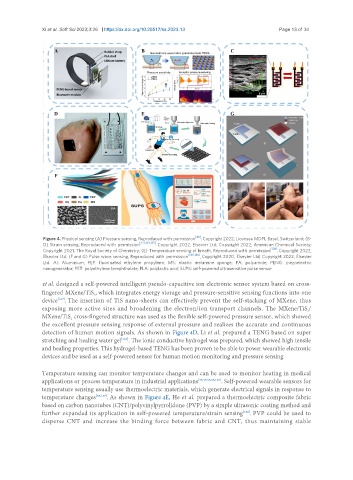
                Figure 4. Physical sensing (A) Pressure sensing, Reproduced with permission  . Copyright 2022, Licensee MDPI, Basel, Switzerland; (B-
                                                [127,134,135]
                D) Strain sensing, Reproduced with  permission  . Copyright 2022, Elsevier Ltd; Copyright 2022, American Chemical Society;
                                                                                            [138]
                Copyright 2021, The Royal Society of Chemistry; (E) Temperature sensing of breath, Reproduced with  permission  , Copyright 2022,
                                                                [145,146]
                Elsevier Ltd; (F and G) Pulse wave sensing, Reproduced with  permission  , Copyright 2020, Elsevier Ltd; Copyright 2022, Elsevier
                Ltd. Al:  Aluminium;  FEP:  fluorinated  ethylene  propylene;  MS:  elastic  melamine  sponge;  PA:  polyamide;  PENG:  piezoelectric
                nanogenerator; PET: polyethylene terephthalate; PLA: polylactic acid; SUPS: self-powered ultrasensitive pulse sensor.
               et al. designed a self-powered intelligent pseudo-capacitive ion electronic sensor system based on cross-
               fingered MXene/TiS , which integrates energy storage and pressure-sensitive sensing functions into one
                                 2
               device . The insertion of TiS nano-sheets can effectively prevent the self-stacking of MXene, thus
                    [127]
               exposing more active sites and broadening the electron/ion transport channels. The MXene/TiS /
                                                                                                         2
               MXene/TiS  cross-fingered structure was used as the flexible self-powered pressure sensor, which showed
                         2
               the excellent pressure sensing response of external pressure and realizes the accurate and continuous
               detection of human motion signals. As shown in Figure 4D, Li et al. prepared a TENG based on super
               stretching and healing water gel . The ionic conductive hydrogel was prepared, which showed high tensile
                                          [135]
               and healing properties. This hydrogel-based TENG has been proven to be able to power wearable electronic
               devices and be used as a self-powered sensor for human motion monitoring and pressure sensing.


               Temperature sensing can monitor temperature changes and can be used to monitor heating in medical
               applications or process temperature in industrial applications [33,37,55,86,136] . Self-powered wearable sensors for
               temperature sensing usually use thermoelectric materials, which generate electrical signals in response to
               temperature changes [98,137] . As shown in Figure 4E, He et al. prepared a thermoelectric composite fabric
               based on carbon nanotubes (CNT)/polyvinylpyrrolidone (PVP) by a simple ultrasonic coating method and
               further expanded its application in self-powered temperature/strain sensing . PVP could be used to
                                                                                   [138]
               disperse CNT and increase the binding force between fabric and CNT, thus maintaining stable

