


Page 9 - Read Online
P. 9
Brasier et al. Soft Sci 2024;4:6  https://dx.doi.org/10.20517/ss.2023.39         Page 7 of 10

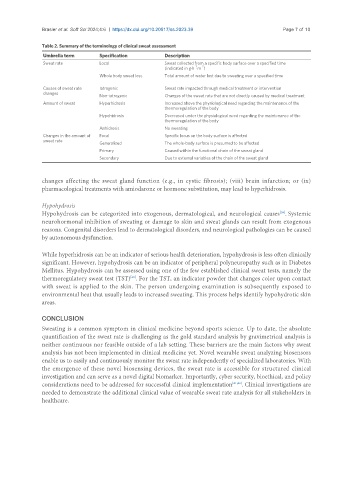
               Table 2. Summary of the terminology of clinical sweat assessment
                Umbrella term      Specification         Description
                Sweat rate         Local                 Sweat collected from a specific body surface over a specified time
                                                                   -1  -2
                                                         (indicated in g·h ·m )
                                   Whole body sweat loss  Total amount of water lost due to sweating over a specified time
                Causes of sweat rate   Iatrogenic        Sweat rate impacted through medical treatment or intervention
                changes
                                   Non-iatrogenic        Changes of the sweat rate that are not directly caused by medical treatment
                Amount of sweat    Hyperhidrosis         Increased above the physiological need regarding the maintenance of the
                                                         thermoregulation of the body
                                   Hypohidrosis          Decreased under the physiological need regarding the maintenance of the
                                                         thermoregulation of the body
                                   Anhidrosis            No sweating
                Changes in the amount of   Focal         Specific locus on the body surface is affected
                sweat rate
                                   Generalized           The whole-body surface is presumed to be affected
                                   Primary               Caused within the functional chain of the sweat gland
                                   Secondary             Due to external variables of the chain of the sweat gland


               changes affecting the sweat gland function (e.g., in cystic fibrosis); (viii) brain infarction; or (ix)
               pharmacological treatments with amiodarone or hormone substitution, may lead to hyperhidrosis.

               Hypohydrosis
               Hypohydrosis can be categorized into exogenous, dermatological, and neurological causes . Systemic
                                                                                               [59]
               neurohormonal inhibition of sweating or damage to skin and sweat glands can result from exogenous
               reasons. Congenital disorders lead to dermatological disorders, and neurological pathologies can be caused
               by autonomous dysfunction.


               While hyperhidrosis can be an indicator of serious health deterioration, hypohydrosis is less often clinically
               significant. However, hypohydrosis can be an indicator of peripheral polyneuropathy such as in Diabetes
               Mellitus. Hypohydrosis can be assessed using one of the few established clinical sweat tests, namely the
               thermoregulatory sweat test (TST) . For the TST, an indicator powder that changes color upon contact
                                             [60]
               with sweat is applied to the skin. The person undergoing examination is subsequently exposed to
               environmental heat that usually leads to increased sweating. This process helps identify hypohydrotic skin
               areas.

               CONCLUSION
               Sweating is a common symptom in clinical medicine beyond sports science. Up to date, the absolute
               quantification of the sweat rate is challenging as the gold standard analysis by gravimetrical analysis is
               neither continuous nor feasible outside of a lab setting. These barriers are the main factors why sweat
               analysis has not been implemented in clinical medicine yet. Novel wearable sweat analyzing biosensors
               enable us to easily and continuously monitor the sweat rate independently of specialized laboratories. With
               the emergence of these novel biosensing devices, the sweat rate is accessible for structured clinical
               investigation and can serve as a novel digital biomarker. Importantly, cyber security, bioethical, and policy
               considerations need to be addressed for successful clinical implementation [61,62] . Clinical investigations are
               needed to demonstrate the additional clinical value of wearable sweat rate analysis for all stakeholders in
               healthcare.

