


Page 6 - Read Online
P. 6
Page 4 of 10                            Brasier et al. Soft Sci 2024;4:6  https://dx.doi.org/10.20517/ss.2023.39


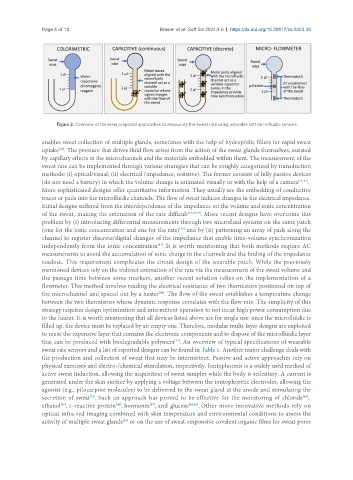
                    Figure 2. Overview of the main proposed approaches to measuring the sweat rate using wearable soft microfluidic sensors.

               enables sweat collection of multiple glands, sometimes with the help of hydrophilic fillers for rapid sweat
               uptake . The pressure that drives fluid flow arises from the action of the sweat glands themselves, assisted
                     [34]
               by capillary effects in the microchannels and the materials embedded within them. The measurement of the
               sweat rate can be implemented through various strategies that can be roughly categorized by transduction
               methods: (i) optical/visual; (ii) electrical (impedance, resistive). The former consists of fully passive devices
               (do not need a battery) in which the volume change is estimated visually or with the help of a camera [35-37] .
               More sophisticated designs offer quantitative information. They usually see the embedding of conductive
               traces or pads into the microfluidic channels. The flow of sweat induces changes in the electrical impedance.
               Initial designs suffered from the interdependence of the impedance on the volume and ionic concentration
               of the sweat, making the estimation of the rate difficult [34,38,39] . More recent designs have overcome this
               problem by (i) introducing differential measurements through two microfluid systems on the same patch
               (one for the ionic concentration and one for the rate)  and by (ii) patterning an array of pads along the
                                                              [40]
               channel to register discrete/digital changes of the impedance that enable time-volume synchronization
                                                      [41]
               independently from the ionic concentration . It is worth mentioning that both methods require AC
               measurements to avoid the accumulation of ionic charge in the channels and the fouling of the impedance
               readout. This requirement complicates the circuit design of the wearable patch. While the previously
               mentioned devices rely on the indirect estimation of the rate via the measurement of the sweat volume and
               the passage time between some markers, another recent solution relies on the implementation of a
               flowmeter. This method involves reading the electrical resistance of two thermistors positioned on top of
               the microchannel and spaced out by a heater . The flow of the sweat establishes a temperature change
                                                       [42]
               between the two thermistors whose dynamic response correlates with the flow rate. The simplicity of this
               strategy requires design optimization and intermittent operation to not incur high power consumption due
               to the heater. It is worth mentioning that all devices listed above are for single use: once the microfluidic is
               filled up, the device must be replaced by an empty one. Therefore, modular multi-layer designs are exploited
               to reuse the expensive layer that contains the electronic components and to dispose of the microfluidic layer
               that can be produced with biodegradable polymers . An overview of typical specifications of wearable
                                                            [43]
               sweat rate sensors and a list of reported designs can be found in Table 1. Another major challenge deals with
               the production and collection of sweat that may be intermittent. Passive and active approaches rely on
               physical exercises and electro-/chemical stimulation, respectively. Iontophoresis is a widely used method of
               active sweat induction, allowing the acquisition of sweat samples while the body is sedentary. A current is
               generated under the skin surface by applying a voltage between the iontophoretic electrodes, allowing the
               agonist (e.g., pilocarpine molecules) to be delivered to the sweat gland at the anode and stimulating the
                               [33]
                                                                                                       [44]
               secretion of sweat . Such an approach has proved to be effective for the monitoring of chloride ,
               ethanol , c-reactive protein , hormones , and glucose [44,48] . Other more innovative methods rely on
                                                   [47]
                     [45]
                                        [46]
               optical infra-red imaging combined with skin temperature and environmental conditions to assess the
               activity of multiple sweat glands  or on the use of sweat-responsive covalent organic films for sweat pores
                                          [49]

