


Page 7 - Read Online
P. 7
Brasier et al. Soft Sci 2024;4:6  https://dx.doi.org/10.20517/ss.2023.39         Page 5 of 10

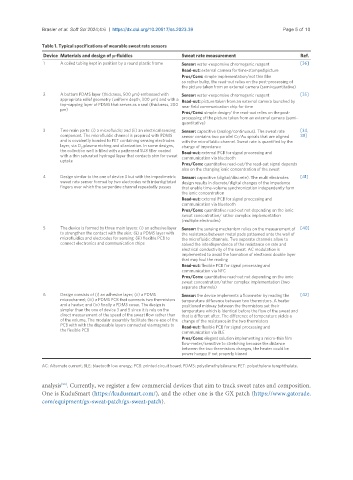
               Table 1. Typical specifications of wearable sweat rate sensors
                Device Materials and design of µ-fluidics     Sweat rate measurement                  Ref.
                1    A coiled tubing kept in position by a round plastic frame  Sensor: water-responsive chromogenic reagent   [36]
                                                              Read-out: external camera for time-stamped picture
                                                              Pros/Cons: simple implementation/not thin film
                                                              so rather bulky, the read-out relies on the post-processing of
                                                              the picture taken from an external camera (semi-quantitative)
                2    A bottom PDMS layer (thickness, 500 μm) embossed with   Sensor: water-responsive chromogenic reagent   [35]
                     appropriate relief geometry (uniform depth, 300 μm) and with a   Read-out: picture taken from an external camera launched by
                     top-capping layer of PDMS that serves as a seal (thickness, 200   near field communication chip for time
                     μm)
                                                              Pros/Cons: simple design/ the read-out relies on the post-
                                                              processing of the picture taken from an external camera (semi-
                                                              quantitative)
                3    Two main parts: (i) a microfluidic; and (ii) an electrical sensing   Sensor: capacitive (analog/continuous). The sweat rate   [34,
                     component. The microfluidic channel is prepared with PDMS   sensor contains two parallel Cr/Au spirals that are aligned   38]
                     and is covalently bonded to PET containing sensing electrodes   with the microfluidic channel. Sweat rate is quantified by the
                     layer, via O  plasma etching and silanization. In some designs,   change of impedance
                            2
                     the collection well is filled with a patterned SU8 filler coated   Read-out: external PCB for signal processing and
                     with a thin saturated hydrogel layer that contacts skin for sweat   communication via bluetooth
                     uptake
                                                              Pros/Cons: quantitative read-out/the read-out signal depends
                                                              also on the changing ionic concentration of the sweat
                4    Design similar to the one of device 3 but with the impedimetric   Sensor: capacitive (digital/discrete). The multi electrodes   [41]
                     sweat rate sensor formed by two electrodes with interdigitated   design results in discrete/digital changes of the impedance
                     fingers over which the serpentine channel repeatedly passes  that enable time-volume synchronization independently form
                                                              the ionic concentration
                                                              Read-out: external PCB for signal processing and
                                                              communication via bluetooth
                                                              Pros/Cons: quantitative read-out not depending on the ionic
                                                              sweat concentration/ rather complex implementation
                                                              (multiple electrodes)
                5    The device is formed by three main layers: (i) an adhesive layer  Sensor: the sensing mechanism relies on the measurement of  [40]
                     to strengthen the contact with the skin; (ii) a PDMS layer with   the resistance between metal pads patterned onto the wall of
                     microfluidics and electrodes for sensing; (iii) flexible PCB to   the microfluidic channels. Two separate channels allow to
                     connect electronics and communication chips  solved the interdependence of the resistance on rate and
                                                              electrical conductivity of the sweat. AC modulation is
                                                              implemented to avoid the formation of electronic double layer
                                                              that may foul the reading
                                                              Read-out: flexible PCB for signal processing and
                                                              communication via NFC
                                                              Pros/Cons: quantitative read-out not depending on the ionic
                                                              sweat concentration/rather complex implementation (two
                                                              separate channels)
                6    Design consists of (i) an adhesive layer; (ii) a PDMS   Sensor: the device implements a flowmeter by reading the   [42]
                     microchannel; (iii) a PDMS PCB that connects two thermistors   temperature difference between two thermistors. A heater
                     and a heater; and (iv) finally a PDMS cover. The design is   positioned midway between the thermistors set their
                     simpler than the one of device 3 and 5 since it is rely on the   temperature which is identical before the flow of the sweat and
                     direct measurement of the speed of the sweat flow rather than   that is different after. The difference of temperature yields a
                     of the volume. The modular assembly facilitate the re-use of the  change of the resistance in the two thermistors
                     PCB with with the disposable layers connected via magnets to   Read-out: flexible PCB for signal processing and
                     the flexible PCB
                                                              communication via BLE
                                                              Pros/Cons: elegant solution implementing a micro-thin film
                                                              flow-meter/sensitive to stretching because the distance
                                                              between the two thermistors changes, the heater could be
                                                              power hungry if not properly biased

               AC: Alternate current; BLE: bluetooth low energy; PCB: printed circuit board; PDMS: polydimethylsiloxane; PET: polyethylene terephthalate.

               analysis . Currently, we register a few commercial devices that aim to track sweat rates and composition.
                      [50]
               One is KuduSmart (https://kudusmart.com/), and the other one is the GX patch (https://www.gatorade.
               com/equipment/gx-sweat-patch/gx-sweat-patch).

