


Page 74 - Read Online
P. 74
Lin et al. Soft Sci 2023;3:14  https://dx.doi.org/10.20517/ss.2023.05           Page 11 of 25


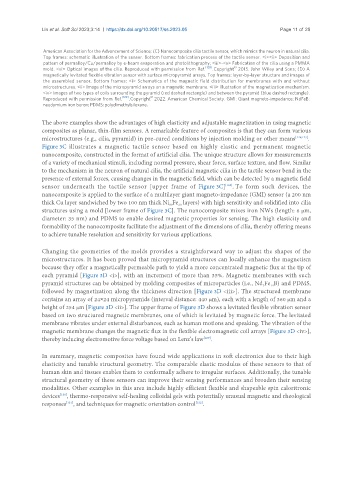
                American Association for the Advancement of Science; (C) Nanocomposite cilia tactile sensor, which mimics the neuron in natural cilia.
                Top frames: schematic illustration of the sensor. Bottom frames: fabrication process of the tactile sensor. <i><ii> Deposition and
                pattern of permalloy/Cu/permalloy by e-beam evaporation and photolithography; <iii>-<v> Fabrication of the cilia using a PMMA
                                                                                ©
                mold. <vi> Optical images of the cilia. Reproduced with permission from  Ref. [128] . Copyright  2015. John Wiley and Sons; (D) A
                magnetically levitated flexible vibration sensor with surface micropyramid arrays. Top frames: layer-by-layer structure and images of
                the  assembled  sensor.  Bottom  frames:  <i>  Schematics  of  the  magnetic  field  distribution  for  membranes  with  and  without
                microstructures. <ii> Image of the micropyramid arrays on a magnetic membrane. <iii> Illustration of the magnetization mechanism.
                <iv> Images of two types of coils surrounding the pyramid (red dashed rectangle) and between the pyramid (blue dashed rectangle).
                                                    ©
                Reproduced with permission from  Ref. [129] . Copyright  2022. American Chemical Society. GMI: Giant magneto-impedance; NdFeB:
                neodymium iron boron; PDMS: polydimethylsiloxane.

               The above examples show the advantages of high elasticity and adjustable magnetization in using magnetic
               composites as planar, thin-film sensors. A remarkable feature of composites is that they can form various
               microstructures (e.g., cilia, pyramid) in pre-cured conditions by injection molding or other means [126,127] .
               Figure 3C  illustrates  a  magnetic  tactile  sensor  based  on  highly  elastic  and  permanent  magnetic
               nanocomposite, constructed in the format of artificial cilia. The unique structure allows for measurements
               of a variety of mechanical stimuli, including normal pressure, shear force, surface texture, and flow. Similar
               to the mechanism in the neuron of natural cilia, the artificial magnetic cilia in the tactile sensor bend in the
               presence of external forces, causing changes in the magnetic field, which can be detected by a magnetic field
               sensor  underneath  the  tactile  sensor  [upper  frame  of  Figure 3C] . To  form  such  devices,  the
                                                                             [128]
               nanocomposite is applied to the surface of a multilayer giant magneto-impedance (GMI) sensor (a 200 nm
               thick Cu layer sandwiched by two 100 nm thick Ni Fe  layers) with high sensitivity and solidified into cilia
                                                          80
                                                             20
               structures using a mold [lower frame of Figure 3C]. The nanocomposite mixes iron NWs (length: 6 μm,
               diameter: 35 nm) and PDMS to enable desired magnetic properties for sensing. The high elasticity and
               formability of the nanocomposite facilitate the adjustment of the dimensions of cilia, thereby offering means
               to achieve tunable resolution and sensitivity for various applications.


               Changing the geometries of the molds provides a straightforward way to adjust the shapes of the
               microstructures. It has been proved that micropyramid structures can locally enhance the magnetism
               because they offer a magnetically permeable path to yield a more concentrated magnetic flux at the tip of
               each pyramid [Figure 3D <i>], with an increment of more than 35%. Magnetic membranes with such
               pyramid structures can be obtained by molding composites of microparticles (i.e., Nd Fe B) and PDMS,
                                                                                          2
                                                                                            14
               followed by magnetization along the thickness direction [Figure 3D <iii>]. The structured membrane
               contains an array of 24×24 micropyramids (interval distance: 440 μm), each with a length of 360 μm and a
               height of 254 μm [Figure 3D <ii>]. The upper frame of Figure 3D shows a levitated flexible vibration sensor
               based on two structured magnetic membranes, one of which is levitated by magnetic force. The levitated
               membrane vibrates under external disturbances, such as human motions and speaking. The vibration of the
               magnetic membrane changes the magnetic flux in the flexible electromagnetic coil arrays [Figure 3D <iv>],
               thereby inducing electromotive force voltage based on Lenz’s law .
                                                                      [129]

               In summary, magnetic composites have found wide applications in soft electronics due to their high
               elasticity and tunable structural geometry. The comparable elastic modulus of these sensors to that of
               human skin and tissues enables them to conformally adhere to irregular surfaces. Additionally, the tunable
               structural geometry of these sensors can improve their sensing performances and broaden their sensing
               modalities. Other examples in this area include highly efficient flexible and shapeable spin caloritronic
                     [130]
               devices , thermo-responsive self-healing colloidal gels with potentially unusual magnetic and rheological
               responses , and techniques for magnetic orientation control .
                                                                   [132]
                       [131]

