


Page 169 - Read Online
P. 169
Page 8 of 15                              Tu et al. Soft Sci 2023;3:25  https://dx.doi.org/10.20517/ss.2023.15


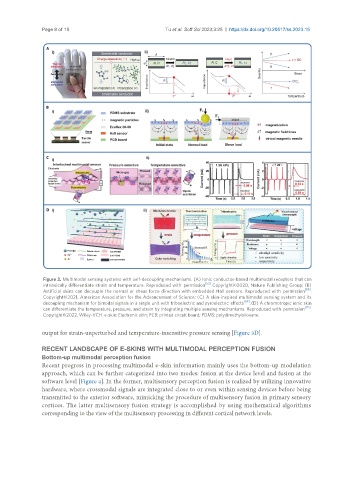
                Figure 3. Multimodal sensing systems with self-decoupling mechanisms. (A) Ionic conductor-based multimodal receptors that can
                intrinsically differentiate strain and temperature. Reproduced with  permission [53] . Copyright©2020, Nature Publishing Group; (B)
                Artificial skins can decouple the normal or shear force direction with embedded Hall sensors. Reproduced with  permission [68] .
                Copyright©2021, American Association for the Advancement of Science; (C) A skin-inspired multimodal sensing system and its
                decoupling mechanism for bimodal signals in a single unit with triboelectric and pyroelectric  effects [69] ; (D) A chromotropic ionic skin
                can differentiate the temperature, pressure, and strain by integrating multiple sensing mechanisms. Reproduced with  permission [70] .
                Copyright©2022, Wiley-VCH. e-skin: Electronic skin; PCB: printed circuit board; PDMS: polydimethylsiloxane.

               output for strain-unperturbed and temperature-insensitive pressure sensing [Figure 3D].


               RECENT LANDSCAPE OF E-SKINS WITH MULTIMODAL PERCEPTION FUSION
               Bottom-up multimodal perception fusion
               Recent progress in processing multimodal e-skin information mainly uses the bottom-up modulation
               approach, which can be further categorized into two modes: fusion at the device level and fusion at the
               software level [Figure 4]. In the former, multisensory perception fusion is realized by utilizing innovative
               hardware, where crossmodal signals are integrated close to or even within sensing devices before being
               transmitted to the exterior software, mimicking the procedure of multisensory fusion in primary sensory
               cortices. The latter multisensory fusion strategy is accomplished by using mathematical algorithms
               corresponding to the view of the multisensory processing in different cortical network levels.

