


Page 108 - Read Online
P. 108
Review  |  Open Access

                                       Plastic and Aesthetic

                                                    Research


                                      Kant et al. Plast Aesthet Res. 2026;13:4      DOI:10.20517/2347-9264.2025.84

               The role of the behavioral health provider in

               supporting patients undergoing gender-affirming
               genital reconstructive surgery


               Jessica D. Kant  , Kirsten M. Kuhn-Kutteh, Frances W. Grimstad  , Elizabeth R. Boskey


               Keywords:
               Gender affirming surgery,
               transgender,
               multidisciplinary team,
               behavioral health support,
               trauma-informed care

               Citation: Kant JD,
               Kuhn-Kutteh KM,
               Grimstad FW, Boskey ER.
               The role of the behavioral
               health provider in supporting
               patients undergoing
               gender-affirming genital
               reconstructive surgery. Plast
               Aesthet Res. 2026;13:4.
               https://dx.doi.org/10.20517
               /2347-9264.2025.84
                                   Abstract
               Received: 13 Aug 2025
               First Decision: 3 Dec  As   gender-affirming   surgery   becomes   more   widely   available,   the   demand   for   such
               2025                procedures has increased accordingly. Where once genital reconstructive surgeries, such
               Revised: 13 Dec 2025  as vulvovaginoplasty, metoidioplasty, and phalloplasty, were accessible only to a select few
               Accepted: 14 Jan 2026  individuals in a limited number of facilities, they are now offered to a broader cross-section
               Published: 27 Jan 2026
                                   of prospective patients. The life experiences, social environments, and support available to
               Academic Editors:   these patients vary widely, and many can benefit from the support of behavioral health
               Gennaro Selvaggi, Miroslav  professionals. While this is true for many types of reconstructive surgery, gender-affirming
               L. Djordjevic       genital surgeries have the potential to dramatically reshape how individuals relate to their
               Copy Editor:
               Ting-Ting Hu        bodies across numerous domains - affecting not just gender congruence, but also sexuality
               Production Editor:  and   daily   activities   such   as   toileting.   Behavioral   health   providers   play   a   crucial   role   in
               Ting-Ting Hu
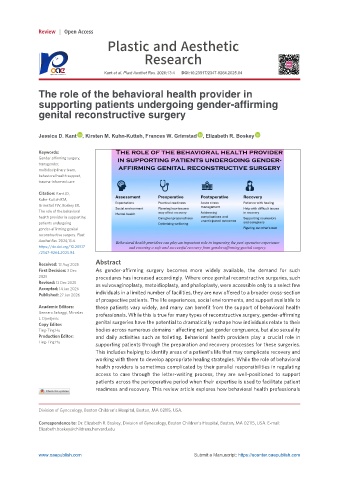
                                   supporting patients through the preparation and recovery processes for these surgeries.
                                   This includes helping to identify areas of a patient’s life that may complicate recovery and
                                   working with them to develop appropriate healing strategies. While the role of behavioral
                                   health providers is sometimes complicated by their parallel responsibilities in regulating
                                   access   to   care   through   the   letter-writing   process,   they   are   well-positioned   to   support
                                   patients across the perioperative period when their expertise is used to facilitate patient
                                   readiness and recovery. This review article explores how behavioral health professionals


               Division of Gynecology, Boston Children’s Hospital, Boston, MA 02115, USA.

               Correspondence to: Dr. Elizabeth R. Boskey, Division of Gynecology, Boston Children’s Hospital, Boston, MA 02115, USA. E-mail:
               Elizabeth.boskey@childrens.harvard.edu


               www.oaepublish.com                                    Submit a Manuscript: https://ucenter.oaepublish.com

