


Page 103 - Read Online
P. 103
Page 10 of 14    Bonapace-Potvin et al. Plast Aesthet Res. 2025;12:34  https://dx.doi.org/10.20517/2347-9264.2025.65


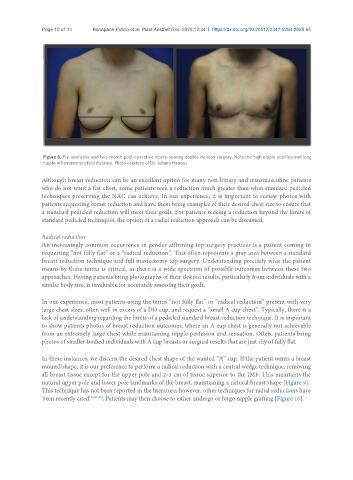
                Figure 8. Pre-operative and two-month post-operative nipple-sparing double incision surgery. Note the high nipple position and long
                nipple-inframammary fold distance. Photo courtesy of Dr. Juliana Hansen.

               Although breast reduction can be an excellent option for many non-binary and transmasculine patients
               who do not want a flat chest, some patients seek a reduction much greater than what standard pedicled
               techniques preserving the NAC can achieve. In our experience, it is important to review photos with
               patients requesting breast reduction and have them bring examples of their desired chest size to ensure that
               a standard pedicled reduction will meet their goals. For patients seeking a reduction beyond the limits of
               standard pedicled techniques, the option of a radial reduction approach can be discussed.

               Radical reduction
               An increasingly common occurrence in gender-affirming top surgery practices is a patient coming in
               requesting “not fully flat” or a “radical reduction”. This often represents a gray area between a standard
               breast reduction technique and full mastectomy top surgery. Understanding precisely what the patient
               means by these terms is critical, as there is a wide spectrum of possible outcomes between these two
               approaches. Having patients bring photographs of their desired results, particularly from individuals with a
               similar body size, is invaluable for accurately assessing their goals.


               In our experience, most patients using the terms “not fully flat” or “radical reduction” present with very
               large chest sizes, often well in excess of a DD cup, and request a “small A cup chest”. Typically, there is a
               lack of understanding regarding the limits of a pedicled standard breast reduction technique. It is important
               to show patients photos of breast reduction outcomes, where an A cup chest is generally not achievable
               from an extremely large chest while maintaining nipple perfusion and sensation. Often, patients bring
               photos of smaller-bodied individuals with A cup breasts or surgical results that are just shy of fully flat.


               In these instances, we discern the desired chest shape of the wanted “A” cup. If the patient wants a breast
               mound/shape, it is our preference to perform a radical reduction with a central wedge technique, removing
               all breast tissue except for the upper pole and 2-3 cm of tissue superior to the IMF. This maintains the
               natural upper pole and lower pole landmarks of the breast, maintaining a natural breast shape [Figure 9].
               This technique has not been reported in the literature; however, other techniques for radial reductions have
               been recently cited [23,28,29] . Patients may then choose to either undergo or forgo nipple grafting [Figure 10].

