


Page 104 - Read Online
P. 104
Bonapace-Potvin et al. Plast Aesthet Res. 2025;12:34  https://dx.doi.org/10.20517/2347-9264.2025.65  Page 11 of 14


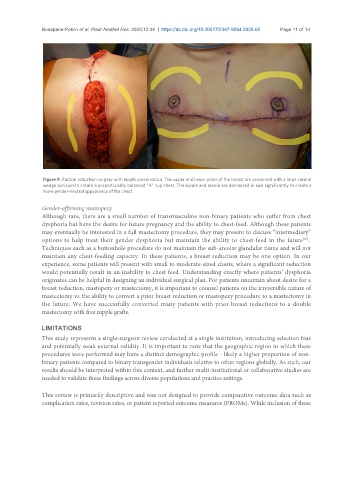
                Figure 9. Radical reduction surgery with nipple preservation. The upper and lower poles of the breast are preserved with a large central
                wedge excision to create a proportionally balanced “A” cup chest. The nipple and areola are decreased in size significantly to create a
                more gender-neutral appearance of the chest.

               Gender-affirming mastopexy
               Although rare, there are a small number of transmasculine non-binary patients who suffer from chest
               dysphoria but have the desire for future pregnancy and the ability to chest-feed. Although these patients
               may eventually be interested in a full mastectomy procedure, they may present to discuss “intermediary”
                                                                                                       [30]
               options to help treat their gender dysphoria but maintain the ability to chest-feed in the future .
               Techniques such as a buttonhole procedure do not maintain the sub-areolar glandular tissue and will not
               maintain any chest-feeding capacity. In these patients, a breast reduction may be one option. In our
               experience, some patients will present with small to moderate-sized chests, where a significant reduction
               would potentially result in an inability to chest feed. Understanding exactly where patients’ dysphoria
               originates can be helpful in designing an individual surgical plan. For patients uncertain about desire for a
               breast reduction, mastopexy or mastectomy, it is important to counsel patients on the irreversible nature of
               mastectomy vs. the ability to convert a prior breast reduction or mastopexy procedure to a mastectomy in
               the future. We have successfully converted many patients with prior breast reductions to a double
               mastectomy with free nipple grafts.

               LIMITATIONS
               This study represents a single-surgeon review conducted at a single institution, introducing selection bias
               and potentially weak external validity. It is important to note that the geographic region in which these
               procedures were performed may have a distinct demographic profile - likely a higher proportion of non-
               binary patients compared to binary transgender individuals relative to other regions globally. As such, our
               results should be interpreted within this context, and further multi-institutional or collaborative studies are
               needed to validate these findings across diverse populations and practice settings.

               This review is primarily descriptive and was not designed to provide comparative outcome data such as
               complication rates, revision rates, or patient reported outcome measures (PROMs). While inclusion of these

