


Page 22 - Read Online
P. 22
Page 12 of 22         Ballestri et al. Metab Target Organ Damage 2023;3:1  https://dx.doi.org/10.20517/mtod.2022.23

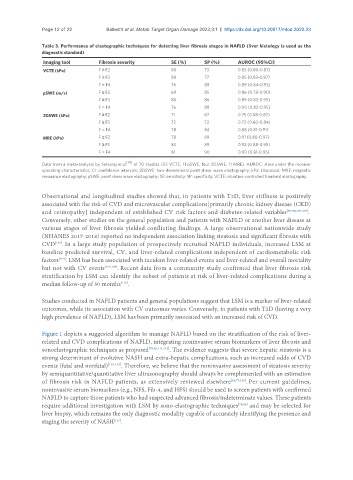
               Table 3. Performance of elastographic techniques for detecting liver fibrosis stages in NAFLD (liver histology is used as the
               diagnostic standard)
                Imaging tool      Fibrosis severity        SE (%)     SP (%)     AUROC (95%CI)
                VCTE (kPa)        F ≥ F2                   80         73         0.83 (0.80-0.87)
                                  F ≥ F3                   80         77         0.85 (0.83-0.87)
                                  F = F4                   76         88         0.89 (0.84-0.93)
                pSWE (m/s)        F ≥ F2                   69         85         0.86 (0.78-0.90)
                                  F ≥ F3                   80         86         0.89 (0.83-0.95)
                                  F = F4                   76         88         0.90 (0.82-0.95)
                2DSWE (kPa)       F ≥ F2                   71         67         0.75 (0.58-0.87)
                                  F ≥ F3                   72         72         0.72 (0.60-0.84)
                                  F = F4                   78         84         0.88 (0.81-0.91)
                MRE (kPa)         F ≥ F2                   78         89         0.91 (0.80-0.97)
                                  F ≥ F3                   83         89         0.92 (0.88-0.95)
                                  F = F4                   81         90         0.90 (0.81-0.95)
                                            [87]
               Data from a meta-analysis by Selvaraj et al.   of 70 studies (53 VCTE, 11 pSWE, four 2DSWE, 11 MRE). AUROC: Area under the receiver
               operating characteristics; CI: confidence intervals; 2DSWE: two-dimensional point shear wave elastography; kPa: kilopascal; MRE: magnetic
               resonance elastography; pSWE: point shear wave elastography; SE: sensitivity; SP: specificity; VCTE: vibration-controlled transient elastography.

               Observational and longitudinal studies showed that, in patients with T2D, liver stiffness is positively
               associated with the risk of CVD and microvascular complications[primarily chronic kidney disease (CKD)
               and retinopathy] independent of established CV risk factors and diabetes-related variables [96-98,105-107] .
               Conversely, other studies on the general population and patients with NAFLD or another liver disease at
               various stages of liver fibrosis yielded conflicting findings. A large observational nationwide study
               (NHANES 2017-2018) reported no independent association linking steatosis and significant fibrosis with
               CVD . In a large study population of prospectively recruited NAFLD individuals, increased LSM at
                    [102]
               baseline predicted survival, CV, and liver-related complications independent of cardiometabolic risk
               factors . LSM has been associated with incident liver-related events and liver-related and overall mortality
                     [104]
               but not with CV events [104,108] . Recent data from a community study confirmed that liver fibrosis risk
               stratification by LSM can identify the subset of patients at risk of liver-related complications during a
               median follow-up of 50 months .
                                          [110]
               Studies conducted in NAFLD patients and general populations suggest that LSM is a marker of liver-related
               outcomes, while its association with CV outcomes varies. Conversely, in patients with T2D (having a very
               high prevalence of NAFLD), LSM has been primarily associated with an increased risk of CVD.

               Figure 1 depicts a suggested algorithm to manage NAFLD based on the stratification of the risk of liver-
               related and CVD complications of NAFLD, integrating noninvasive serum biomarkers of liver fibrosis and
               sonoelastographic techniques as proposed [78,86,111,112] . The evidence suggests that severe hepatic steatosis is a
               strong determinant of evolutive NASH and extra-hepatic complications, such as increased odds of CVD
               events (fatal and nonfatal) [113-115] . Therefore, we believe that the noninvasive assessment of steatosis severity
               by semiquantitative/quantitative liver ultrasonography should always be complemented with an estimation
               of fibrosis risk in NAFLD patients, as extensively reviewed elsewhere [14,77,116] . Per current guidelines,
               noninvasive serum biomarkers (e.g., NFS, Fib-4, and HFS) should be used to screen patients with confirmed
               NAFLD to capture those patients who had suspected advanced fibrosis/indeterminate values. These patients
               require additional investigation with LSM by sono-elastographic techniques [78,86]  and may be selected for
               liver biopsy, which remains the only diagnostic modality capable of accurately identifying the presence and
               staging the severity of NASH .
                                       [117]

