


Page 17 - Read Online
P. 17
Ballestri et al. Metab Target Organ Damage 2023;3:1     https://dx.doi.org/10.20517/mtod.2022.23                                                                               Page 9 of 22


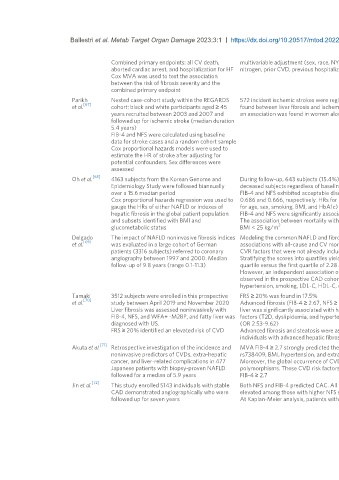
                                        Combined primary endpoints: all CV death,    multivariable adjustment (sex, race, NYHA class, smoking, SBP, serum sodium, blood urea   and clinical outcomes related to HF events
                                        aborted cardiac arrest, and hospitalization for HF  nitrogen, prior CVD, previous hospitalization for HF and ongoing spironolactone)
                                        Cox MVA was used to test the association
                                        between the risk of fibrosis severity and the
                                        combined primary endpoint
                          Parikh        Nested case-cohort study within the REGARDS   572 incident ischemic strokes were registered during follow-up. No significant association was   In women (but not men), there may be an
                              [67]
                          et al.        cohort: black and white participants aged ≥ 45   found between liver fibrosis and ischemic stroke globally with FIB-4 and NFS. Nevertheless, such  association between advanced hepatic fibrosis
                                        years recruited between 2003 and 2007 and    an association was found in women alone using FIB-4                                    and enhanced ischemic stroke risk
                                        followed up for ischemic stroke (median duration
                                        5.4 years)
                                        FIB-4 and NFS were calculated using baseline
                                        data for stroke cases and a random cohort sample
                                        Cox proportional hazards models were used to
                                        estimate the HR of stroke after adjusting for
                                        potential confounders. Sex differences were
                                        assessed
                                  [68]
                          Oh et al.     4163 subjects from the Korean Genome and     During follow-up, 643 subjects (15.4%) died. FIB-4, NFS, and APRI were consistently higher in   In Koreans, noninvasive assessment of fibrosis
                                        Epidemiology Study were followed biannually   deceased subjects regardless of baseline glucose metabolism status                    correlates with overall and hepato-specific
                                        over a 15.6 median period                    FIB-4 and NFS exhibited acceptable discrimination power for mortality, with AUROC values of   mortality
                                        Cox proportional hazards regression was used to  0.686 and 0.666, respectively. HRs for FIB-4 and NFS were 1.41 and 1.43, respectively (adjusted
                                        gauge the HRs of either NAFLD or indexes of   for age, sex, smoking, BMI, and HbA1c)
                                        hepatic fibrosis in the global patient population   FIB-4 and NFS were significantly associated with liver-specific mortality but not CV mortality
                                        and subsets identified with BMI and          The association between mortality with fibrosis indices was more marked among subjects with
                                                                                                   2
                                        glucometabolic status                        BMI < 25 kg/m
                          Delgado       The impact of NAFLD noninvasive fibrosis indices  Modeling the common NAFLD and fibrosis scores, FIB-4 and NFS, as splines revealed significant  Noninvasive indices of fibrosing NAFLD do not
                              [69]
                          et al.        was evaluated in a large cohort of German    associations with all-cause and CV mortality when Cox regression models were only adjusted for  offer additional data in assessing CVD events
                                        patients (3316 subjects) referred to coronary   CVR factors that were not already included in the calculation of the scores         among angiography-proven CAD
                                        angiography between 1997 and 2000. Median    Stratifying the scores into quartiles yielded HRs for all-cause and CV mortality for the fourth
                                        follow-up of 9.8 years (range 0.1-11.3)      quartile versus the first quartile of 2.28 and 2.11 for FIB-4 and 3.21 and 3.12 for NFS
                                                                                     However, an independent association of FIB-4 or NFS with overall or CV mortality was not
                                                                                     observed in the prospective CAD cohort after full adjustment for age, sex, BMI, T2D,
                                                                                     hypertension, smoking, LDL-C, HDL-C, medication, and alcohol intake
                          Tamaki        3512 subjects were enrolled in this prospective   FRS ≥ 20% was found in 17.5%                                                      CVD risk was associated with liver fibrosis and
                              [70]
                          et al.        study between April 2019 and November 2020   Advanced fibrosis (FIB-4 ≥ 2.67, NFS ≥ 0.675, and WFA+ -M2BP ≥ 1.0) and the presence of fatty  steatosis irrespective of CVR copathologies
                                        Liver fibrosis was assessed noninvasively with   liver was significantly associated with high CVD risk independent of metabolic confounding   suggesting that these hepatic conditions may
                                        FIB-4, NFS, and WFA+ -M2BP, and fatty liver was  factors (T2D, dyslipidemia, and hypertension)                                      help disclose individuals at a high CVR
                                        diagnosed with US.                           (OR 2.53-9.62)
                                        FRS ≥ 20% identified an elevated risk of CVD  Advanced fibrosis and steatosis were associated with the most elevated CVD risk. Next were
                                                                                     individuals with advanced hepatic fibrosis in the absence of steatosis
                                    [71]
                          Akuta et al.  Retrospective investigation of the incidence and   MVA FIB-4 ≥ 2.7 strongly predicted the three disease outcomes, independently of CKD, PNPLA3  Data have shown that the FIB-4 index ≥ 2.67
                                        noninvasive predictors of CVDs, extra-hepatic   rs738409, BMI, hypertension, and extra-hepatic malignancies                         (and PNPLA3 genotype) affects the incidence
                                        cancer, and liver-related complications in 477   Moreover, the global occurrence of CVDs significantly differed among the various PNPLA3   of complications, particularly CVDs, among
                                        Japanese patients with biopsy-proven NAFLD   polymorphisms. These CVD risk factors could be attributed to CC PNPLA3 genotype, CKD, and   Japanese NAFLD patients
                                        followed for a median of 5.9 years           FIB-4 ≥ 2.7
                                 [72]
                          Jin et al.    This study enrolled 5143 individuals with stable   Both NFS and FIB-4 predicted CAC. All CAD severity parameters were significantly more   NFS and FIB-4 were significantly associated
                                        CAD demonstrated angiographically who were   elevated among those with higher NFS scores                                            with CAD severity, CAC, and CVEs
                                        followed up for seven years                  At Kaplan-Meier analysis, patients with intermediate and high NFS and FIB-4 scores had a higher

