


Page 15 - Read Online
P. 15
Page 8 of 22                                                                               Ballestri et al. Metab Target Organ Damage 2023;3:1     https://dx.doi.org/10.20517/mtod.2022.23


                                                                                     Among MAFLD individuals, having a low muscle mass was associated with a higher risk of
                                                                                     significant liver fibrosis (OR = 1.56 to 2.43; P < 0.001), and similar findings were observed when
                                                                                     significant hepatic fibrosis was defined with NFS
                          Longitudinal

                                   [62]
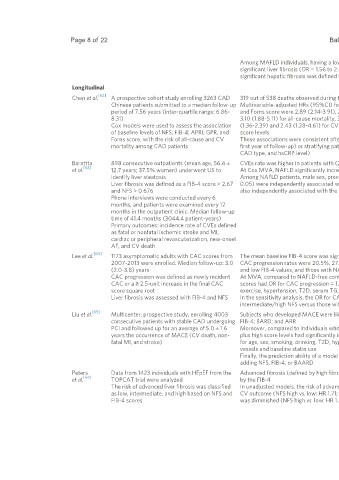
                          Chen et al.   A prospective cohort study enrolling 3263 CAD   319 out of 538 deaths observed during this study were due to CVD                    Among CAD patients, higher liver fibrosis
                                        Chinese patients submitted to a median follow-up  Multivariable-adjusted HRs (95%CI) for those with the highest levels of NFS, FIB-4, APRI, GPR,   scores and noninvasive biomarkers are
                                        period of 7.56 years (inter-quartile range: 6.86-  and Forns score were 2.89 (2.14-3.91), 2.84 (2.14-3.76), 1.77 (1.33-2.36), 1.47 (1.19-1.83) and   associated with increased mortality owing to all
                                        8.31)                                        3.10 (1.88-5.11) for all-cause mortality, 3.02 (2.05-4.45), 3.34 (2.29-4.86), 1.99 (1.40-2.83), 1.80  causes and CVD
                                        Cox models were used to assess the association   (1.36-2.39) and 2.43 (1.28-4.61) for CV mortality, respectively, compared to patients with lowest
                                        of baseline levels of NFS; FIB-4; APRI; GPR, and   score levels
                                        Forns score, with the risk of all-cause and CV   These associations were consistent after ruling out early deaths (i.e., those occurring within the
                                        mortality among CAD patients                 first year of follow-up) or stratifying patients (by sex, age, BMI, diabetes status, MetS status,
                                                                                     CAD type, and hsCRP level)
                          Barattta      898 consecutive outpatients (mean age, 56.4 ±   CVEs rate was higher in patients with (2.1%/year) than without NAFLD (1.0%/year) (P > 0.05)   Liver fibrosis indexes are strongly associated
                              [63]
                          et al.        12.7 years; 37.5% women) underwent US to     At Cox MVA, NAFLD significantly increased the risk of CVEs (HR 2.41) after adjusting for MetS.  with incident CVEs among NAFLD individuals
                                        identify liver steatosis                     Among NAFLD patients, male sex, previous CVEs, MetS, and FIB-4 scores > 2.67 (HR 4.02; P <
                                        Liver fibrosis was defined as a FIB-4 score > 2.67  0.05) were independently associated with the risk of incident CVEs. NFS scores > 0.676 were
                                        and NFS > 0.676                              also independently associated with the risk of incident CVEs (HR 2.35; P < 0.05)
                                        Phone interviews were conducted every 6
                                        months, and patients were examined every 12
                                        months in the outpatient clinic. Median follow-up
                                        time of 41.4 months (3044.4 patient-years)
                                        Primary outcomes: incidence rate of CVEs defined
                                        as fatal or nonfatal ischemic stroke and MI,
                                        cardiac or peripheral revascularization, new-onset
                                        AF, and CV death
                                  [64]
                          Lee et al.    1173 asymptomatic adults with CAC scores from  The mean baseline FIB-4 score was significantly higher in subjects with CAC          Noninvasively assessed advanced liver fibrosis
                                        2007-2013 were enrolled. Median follow-up: 3.0  CAC progression rates were 20.5%, 27.5%, and 35.9% among those NAFLD-free, with NAFLD   associates with an increased chance of CAC
                                        (2.0-3.8) years                              and low FIB-4 values, and those with NAFLD and intermediate/high FIB-4 scores, respectively   progression among NAFLD patients
                                        CAC progression was defined as newly incident   At MVA, compared to NAFLD-free controls, subjects with NAFLD plus intermediate/high FIB-4
                                        CAC or a ≥ 2.5-unit increase in the final CAC   scores had OR for CAC progression = 1.70 after adjustment for sex, BMI, smoking, drinking,
                                        score square root                            exercise, hypertension, T2D, serum TG, HDL-C, LDL-C, and hsCRP
                                        Liver fibrosis was assessed with FIB-4 and NFS  In the sensitivity analysis, the OR for CAC progression was 1.57 for subjects with NAFLD plus an
                                                                                     intermediate/high NFS versus those without NAFLD
                                 [65]
                          Liu et al.    Multicenter, prospective study, enrolling 4003   Subjects who developed MACE were likelier to have either intermediate or high values of NFS;   High values of hepatic fibrosis markers predict
                                        consecutive patients with stable CAD undergoing  FIB-4; BARD; and ARR                                                               adverse outcomes in patients with stable CAD
                                        PCI and followed up for an average of 5.0 ± 1.6   Moreover, compared to individuals who had low fibrosis markers scores, those with intermediate  submitted to PCI, suggesting that these
                                        years the occurrence of MACE (CV death, non-  plus high score levels had significantly increased risk of MACE (aHR 1.57-1.92) after adjustment   markers might also be evaluated in the risk
                                        fatal MI, and stroke)                        for age, sex, smoking, drinking, T2D, hypertension, SBP, LDL-C, HbA1c, hs-CRP, number of lesion  stratification before elective PCI
                                                                                     vessels and baseline statin use
                                                                                     Finally, the prediction ability of a model with established CV risk factors significantly improved by
                                                                                     adding NFS, FIB-4, or BAARD
                          Peters        Data from 1423 individuals with HFpEF from the   Advanced fibrosis (defined by high fibrosis scores) was present in 37.57% of the NFS and 8.02%  Advanced liver fibrosis (assessed with fibrosis
                              [66]
                          et al.        TOPCAT trial were analyzed                   by the FIB-4                                                                           biomarkers) may not be uncommon among
                                        The risk of advanced liver fibrosis was classified   In unadjusted models, the risk of advanced fibrosis was significantly associated with the primary  HFpEF patients
                                        as low, intermediate, and high based on NFS and   CV outcome (NFS high vs. low: HR 1.71; FIB-4 high vs. low: HR 1.56). However, this association   There seems to be a limited independent
                                        FIB-4 scores                                 was diminished (NFS high vs. low: HR 1.35, P > 0.05); FIB-4 high vs. low: HR 1.42, P = 0.05) after  association between liver fibrosis risk scores

