


Page 13 - Read Online
P. 13
Ballestri et al. Metab Target Organ Damage 2023;3:1     https://dx.doi.org/10.20517/mtod.2022.23                                                                               Page 7 of 22


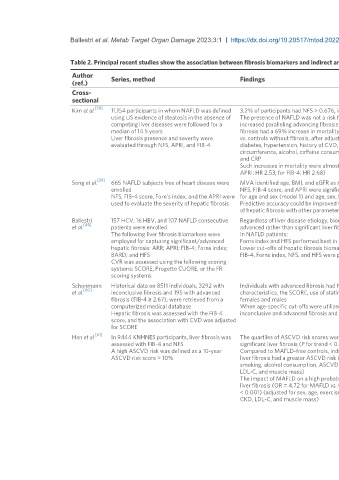
                          Table 2. Principal recent studies show the association between fibrosis biomarkers and indirect and direct evidence of increased CVD risk and mortality among NAFLD patients

                          Author
                          (ref.)        Series, method                               Findings                                                                               Comment
                          Cross-
                          sectional
                                  [58]
                          Kim et al.    11,154 participants in whom NAFLD was defined   3.2% of participants had NFS > 0.676, indicative of advanced fibrosis               While US-diagnosed NAFLD is not associated
                                        using US evidence of steatosis in the absence of   The presence of NAFLD was not a risk factor for increased mortality. Conversely, mortality   with increased mortality, advanced fibrosis,
                                        competing liver diseases were followed for a   increased paralleling advancing fibrosis scores such that those at a high probability of advanced   assessed with noninvasive fibrosis markers,
                                        median of 14.5 years                         fibrosis had a 69% increase in mortality (for NFS: HR 1.69; for APRI: HR 1.85; for FIB-4: HR 1.66)   significantly predicts mortality, mainly owing to
                                        Liver fibrosis presence and severity were    vs. controls without fibrosis, after adjustment for age, sex, race-ethnicity, education, income,   CVD, independent of confounders
                                        evaluated through NFS, APRI, and FIB-4       diabetes, hypertension, history of CVD, lipid-lowering medication, smoking status, waist
                                                                                     circumference, alcohol, caffeine consumption, total cholesterol, HDL-C, transferrin saturation,
                                                                                     and CRP
                                                                                     Such increases in mortality were almost entirely accounted for by CVD (for NFS: HR 3.46; for
                                                                                     APRI: HR 2.53; for FIB-4: HR 2.68)
                                   [59]
                          Song et al.   665 NAFLD subjects free of heart disease were   MVA identified age, BMI, and eGFR as significantly predicted CACS > 100             Widely used blood biomarkers of liver fibrosis
                                        enrolled                                     NFS, FIB-4 score, and APRI were significantly associated with a CAC score > 100 after adjusting:  can identify NAFLD patients with high CVD risk
                                        NFS, FIB-4 score, Forn’s index, and the APRI were  for age and sex (model 1) and age, sex, BMI, and eGFR (model 2)
                                        used to evaluate the severity of hepatic fibrosis  Predictive accuracy could be improved with integrated scores combining noninvasive biomarkers
                                                                                     of hepatic fibrosis with other parameters
                          Ballestri     157 HCV, 16 HBV, and 107 NAFLD consecutive   Regardless of liver disease etiology, biomarkers of hepatic fibrosis performed better in predicting  In NAFLD (and chronic viral hepatitis),
                              [45]
                          et al.        patients were enrolled                       advanced rather than significant liver fibrosis                                        biomarkers of hepatic fibrosis can exclude
                                        The following liver fibrosis biomarkers were   In NAFLD patients:                                                                   advanced fibrosis and are associated with CVR
                                        employed for capturing significant/advanced   Forns index and HFS performed best in predicting advanced fibrosis                    scores
                                        hepatic fibrosis: ARR; APRI; FIB-4; Forns index;   Lower cut-offs of hepatic fibrosis biomarkers had high NPVs for advanced fibrosis
                                        BARD; and HFS                                FIB-4, Forns index, NFS, and HFS were positively correlated with SCORE and FR risk scores
                                        CVR was assessed using the following scoring
                                        systems: SCORE, Progetto CUORE, or the FR
                                        scoring systems
                          Schonmann     Historical data on 8511 individuals, 3292 with   Individuals with advanced fibrosis had higher CVD risk after adjustment for sociodemographic   Fib-4, being independently associated with
                              [60]
                          et al.        inconclusive fibrosis and 195 with advanced   characteristics, the SCORE, use of statins and aspirin (HR 1.63). The association persisted in both  CVD, offers the opportunity for using markers
                                        fibrosis (FIB-4 ≥ 2.67), were retrieved from a   females and males                                                                  of liver fibrosis in CVD risk assessment in
                                        computerized medical database                When age-specific cut-offs were utilized, a significant dose-response association between   primary care
                                        Hepatic fibrosis was assessed with the FIB-4   inconclusive and advanced fibrosis and CVD was found (HR 1.15 and 1.60, respectively)
                                        score, and the association with CVD was adjusted
                                        for SCORE
                                  [61]
                          Han et al.    In 9444 KNHNES participants, liver fibrosis was   The quartiles of ASCVD risk scores were positively correlated to MAFLD and FIB-4 defined-  MAFLD per se carries a substantial ASCVD
                                        assessed with FIB-4 and NFS                  significant liver fibrosis (P for trend < 0.001)                                       risk, further worsened by concomitant
                                        A high ASCVD risk was defined as a 10-year   Compared to MAFLD-free controls, individuals with both MAFLD and FIB-4 defined-significant   significant liver fibrosis. This, in turn, is
                                        ASCVD risk score > 10%                       liver fibrosis had a greater ASCVD risk (OR = 2.40; P < 0.001) (adjusted for sex, age, exercise,   associated with sarcopenia
                                                                                     smoking, alcohol consumption, ASCVD history, SBP, fasting blood glucose, BMI, HOMA-IR, CKD,
                                                                                     LDL-C, and muscle mass)
                                                                                     The impact of MAFLD on a high probability of ASCVD risk was greater than that of significant
                                                                                     liver fibrosis (OR = 4.72 for MAFLD vs. OR = 1.88 for FIB-4 defined-significant liver fibrosis; all P
                                                                                     < 0.001) (adjusted for sex, age, exercise, current smoking, alcohol consumption, ASCVD history,
                                                                                     CKD, LDL-C, and muscle mass)

