


Page 19 - Read Online
P. 19
Page 10 of 22                                                                              Ballestri et al. Metab Target Organ Damage 2023;3:1     https://dx.doi.org/10.20517/mtod.2022.23


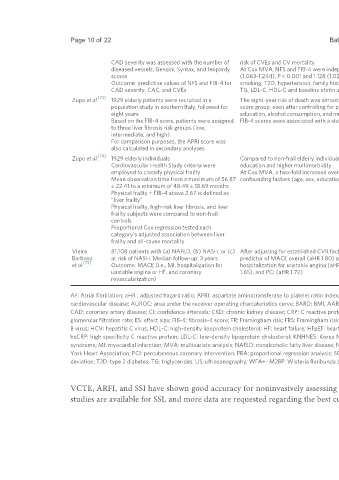
                                        CAD severity was assessed with the number of   risk of CVEs and CV mortality
                                        diseased vessels, Gensini, Syntax, and Jeopardy   At Cox MVA, NFS and FIB-4 were independently associated with CVEs [HR (95%CI): 1.150
                                        scores                                       (1.063-1.244), P < 0.001 and 1.128 (1.026-1.240), P = 0.012] (adjusted for sex, BMI, current
                                        Outcome: predictive values of NFS and FIB-4 for   smoking, T2D, hypertension, family history of CAD, left ventricular ejection fraction, creatinine,
                                        CAD severity, CAC, and CVEs                  TG, LDL-C, HDL-C and baseline statin use)
                                   [73]
                          Zupo et al.   1929 elderly patients were recruited in a    The eight-year risk of death was almost two-fold among individuals in the highest-risk FIB-4   In clinical practice, FIB-4 may help to identify
                                        population study in southern Italy, followed for   score group, even after controlling for possible confounding factors (age, sex, smoking,   individuals at risk of higher mortality
                                        eight years                                  education, alcohol consumption, and multimorbidity)
                                        Based on the FIB-4 score, patients were assigned  FIB-4 scores were associated with a steeper mortality curve than the APRI scores
                                        to three liver fibrosis risk groups (low,
                                        intermediate, and high)
                                        For comparison purposes, the APRI score was
                                        also calculated in secondary analyses
                                   [74]
                          Zupo et al.   1929 elderly individuals                     Compared to non-frail elderly individuals, liver frailty subjects were significantly older, with lower  Compared to non-frail controls, the liver frailty
                                        Cardiovascular Health Study criteria were    education and higher multimorbidity                                                    phenotype - defined based on simple measures
                                        employed to classify physical frailty        At Cox MVA, a two-fold increased overall mortality risk (HR 2.09) was found after adjusting for  primarily available in a primary care setting - is
                                        Mean observation time from a maximum of 56.87  confounding factors (age, sex, education, and alcohol consumption)                   associated with a two-fold increased risk of
                                        ± 22.41 to a minimum of 48.49 ± 18.69 months                                                                                        overall mortality in a patient population from
                                        Physical frailty + FIB-4 above 2.67 is defined as                                                                                   southern Italy
                                        “liver frailty”
                                        Physical frailty, high-risk liver fibrosis, and liver
                                        frailty subjects were compared to non-frail
                                        controls
                                        Proportional Cox regression tested each
                                        category’s adjusted association between liver
                                        frailty and all-cause mortality

                          Vieira        81,108 patients with (a) NAFLD, (b) NASH, or (c)  After adjusting for established CVR factors, FIB-4 ≥ 2.67 remained the strongest independent   FIB-4 ranks as the most accurate predictive
                          Barbosa       at risk of NASH. Median follow-up: 3 years   predictor of MACE overall (aHR 1.80) and was significantly associated with MI (aHR 1.46),   factor of MACE, irrespective of traditional CVR
                              [75]
                          et al.        Outcome: MACE (i.e., MI, hospitalization for   hospitalization for unstable angina (aHR 1.24), hospitalization for HF (aHR 2.09), CABG (aHR   factors and hepatic diagnosis at the baseline
                                        unstable angina or HF, and coronary          1.65), and PCI (aHR 1.72)
                                        revascularization)

                          AF: Atrial fibrillation; aHR : adjusted hazard ratio; APRI: aspartate aminotransferase to platelet ratio index; ARR: aspartate aminotransferase (AST) to alanine aminotransferase (ALT) ratio; ASCVD atherosclerotic
                          cardiovascular disease; AUROC: area under the receiver operating charcateristics curve; BARD: BMI, AAR, Diabetes; BMI: body mass index; CAC: coronary artery calcification; CABG: coronary artery bypass graft;
                          CAD: coronary artery disease; CI: confidence intervals; CKD: chronic kidney disease; CRP: C reactive protein; CVD: cardiovascular disease; CVEs: cardiovascular events; CVR: cardiovascular risk; eGFR: estimated
                          glomerular filtration rate; ES: effect size; FIB-4: fibrosis-4 score; FR: Framingham risk; FRS: Framingham risk score; GPR: gamma-glutamyltransferase-to-platelet ratio; HbA1c: glycosylated hemoglobin; HBV: hepatitis
                          B virus; HCV: hepatitis C virus; HDL-C: high-density lipoprotein cholesterol; HF: heart failure; HFpEF: heart failure with preserved ejection fraction; HFS: Hepamet fibrosis score; aHR: adjusted HR; HR: hazard ratio;
                          hsCRP: high specificity C reactive protein; LDL-C: low-density lipoprotein cholesterol; KNHNES: Korea National Health and Nutrition Examination Survey; MACE: major cardiovascular events; MetS: metabolic
                          syndrome; MI: myocardial infarction; MVA: multivariate analysis; NAFLD: nonalcoholic fatty liver disease; NFS: NAFLD fibrosis score; NPV: negative predictive value; NASH: nonalcoholic steatohepatitis; NYHA: New
                          York Heart Association; PCI: percutaneous coronary intervention; PRA: proportional regression analysis; SCORE: European Systematic Coronary Risk Evaluation calculator; SBP, systolic blood pressure; SD, standard
                          deviation; T2D: type 2 diabetes; TG: triglycerides; US: ultrasonography; WFA+ -M2BP: Wisteria floribunda agglutinin- positive Mac-2 binding protein.


                          VCTE, ARFI, and SSI have shown good accuracy for noninvasively assessing the degree of fibrosis in patients with biopsy-proven NAFLD, although fewer
                          studies are available for SSI, and more data are requested regarding the best cut-off points for ARFI and SSI                     [52,82-85] . However, VCTE and SWE techniques are

