


Page 39 - Read Online
P. 39
Na et al. Mini-invasive Surg 2024;8:31  https://dx.doi.org/10.20517/2574-1225.2024.10  Page 3 of 12

               Table 1. The efficacy index of each zone according to tumor location for esophageal SqCC
                LN zone         Upper esophageal cancer n = 629 Mid esophageal cancer n = 2,215 Lower esophageal cancer n = 983
                Supraclavicular zone  14.1               9.2                     5.3
                Upper mediastinal zone 17.6              15.0                    8.2
                Middle mediastinal zone 3.0              6.1                     4.7
                Lower mediastinal zone 1.4               3.9                     8.4
                Perigastric zone  3.1                    9.3                     17.8
                Celiac zone     0.0                      1.0                     2.9
                                                                  [4]
               This table is adapted from Tachimori et al. Esophagus. 2016;13:1-7. Springer Nature  (https://doi.org/10.1007%2Fs10388-015-0515-3) under the
               terms of the Creative Commons Attribution 4.0 International License (http://creativecommons.org/licenses/by/4.0/). SqCC: Squamous cell
               carcinoma; LN: lymph node.


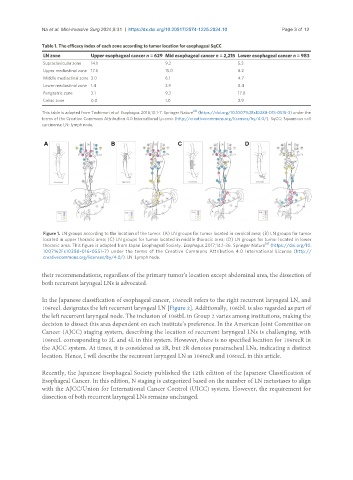
                Figure 1. LN groups according to the location of the tumor. (A) LN groups for tumor located in cervical area; (B) LN groups for tumor
                located in upper thoracic area; (C) LN groups for tumor located in middle thoracic area; (D) LN groups for tumor located in lower
                                                                                          [6]
                thoracic area. This figure is adapted from Japan Esophageal Society.  Esophagus. 2017;14:1-36. Springer Nature  (https://doi.org/10.
                1007%2Fs10388-016-0551-7)  under  the  terms  of  the  Creative  Commons  Attribution  4.0  International  License  (http://
                creativecommons.org/licenses/by/4.0/). LN: Lymph node.

               their recommendations, regardless of the primary tumor’s location except abdominal area, the dissection of
               both recurrent laryngeal LNs is advocated.

               In the Japanese classification of esophageal cancer, 106recR refers to the right recurrent laryngeal LN, and
               106recL designates the left recurrent laryngeal LN [Figure 2]. Additionally, 106tbL is also regarded as part of
               the left recurrent laryngeal node. The inclusion of 106tbL in Group 2 varies among institutions, making the
               decision to dissect this area dependent on each institute’s preference. In the American Joint Committee on
               Cancer (AJCC) staging system, describing the location of recurrent laryngeal LNs is challenging, with
               106recL corresponding to 2L and 4L in this system. However, there is no specified location for 106recR in
               the AJCC system. At times, it is considered as 2R, but 2R denotes paratracheal LNs, indicating a distinct
               location. Hence, I will describe the recurrent laryngeal LN as 106recR and 106recL in this article.


               Recently, the Japanese Esophageal Society published the 12th edition of the Japanese Classification of
               Esophageal Cancer. In this edition, N staging is categorized based on the number of LN metastases to align
               with the AJCC/Union for International Cancer Control (UICC) system. However, the requirement for
               dissection of both recurrent laryngeal LNs remains unchanged.

