


Page 42 - Read Online
P. 42
Page 6 of 12                                                                                   Na et al. Mini-invasive Surg 2024;8:31  https://dx.doi.org/10.20517/2574-1225.2024.10


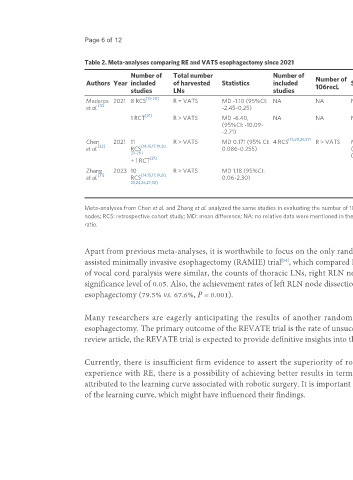
                              Table 2. Meta-analyses comparing RE and VATS esophagectomy since 2021

                                             Number of     Total number                      Number of     Number of                     Number of                  Number of       Palsy
                              Authors Year included        of harvested     Statistics       included      106recL     Statistics        106recR     Statistics     included        rate    Statistics
                                             studies       LNs                               studies                                                                studies
                                                  [13-20]                                                                                                                [13-15,17,19,20]
                              Mederos  2021  8 RCS         R = VATS         MD -1.10 (95%CI:  NA           NA          NA                NA          NA             6 RCS           R =     RD of 0.01 (95%CI:
                                  [12]
                              et al.                                        -2.45~0.25)                                                                                             VATS    -0.08~0.10)
                                                  [21]                                                                                                                   [21]
                                             1 RCT         R > VATS         MD -6.40,        NA            NA          NA                NA          NA             1 RCT           R =     RD of -0.03 (95% CI:
                                                                            (95%CI: -10.09~                                                                                         VATS    -0.11~0.05)
                                                                            -2.71)
                                                                                                  [15,20,26,27]
                              Chen     2021 11             R > VATS         MD 0.171 (95% CI:  4 RCS       R > VATS    MD 0.219          R = VATS    MD 0.10        13              R =     RR 0.88 (95%CI:
                                  [22]           [14,15,17,19,20,                                                                                                       [13,14,15,17,19,20,
                              et al.         RCS                            0.086~0.255)                               (95%CI:                       (95%CI: -      RCS             VATS    0.67~1.14)
                                             23-28]                                                                                                                 23,24,26-30]
                                                    [21]                                                               0.097~0.340)                  0.06~0.26)            [21]
                                             + 1 RCT                                                                                                                + 1 RCT
                              Zhang    2023 10             R > VATS         MD 1.18 (95%CI:                                                                         11              R =     R: 16.28% vs. VATS
                                  [31]           [14,15,17,19,20,                                                                                                       [14,15,17,20,23,24,
                              et al.         RCS                            0.06~2.30)                                                                              RCS             VATS    21.96% (OR = 0.80;
                                             23,24,26,27,32]                                                                                                        26,27,29,30,33]
                                                                                                                                                                           [34]             95%CI: 0.57~1.12; P =
                                                                                                                                                                    + 1 RCT                 0.19)
                                                                                                                                         [22,31]
                              Meta-analyses from Chen et al. and Zhang et al. analyzed the same studies in evaluating the number of 106recL and 106recR  . RE: Robotic esophagectomy; VATS: video-assisted thoracic surgery; LNs: lymph
                              nodes; RCS: retrospective cohort study; MD: mean difference; NA: no relative data were mentioned in the original articles; RD: risk difference; RCT: randomized controlled trial; RR: relative risk; R: robot; OR: odds
                              ratio.


                              Apart from previous meta-analyses, it is worthwhile to focus on the only randomized controlled study published in the English literature to date: the robot-
                              assisted minimally invasive esophagectomy (RAMIE) trial , which compared RE and VATS esophagectomy. While the number of dissected LNs and the rate
                                                                                                [34]
                              of vocal cord paralysis were similar, the counts of thoracic LNs, right RLN node, and left RLN node after neoadjuvant therapies were higher in RE, with a

                              significance level of 0.05. Also, the achievement rates of left RLN node dissection after neoadjuvant therapy were significantly higher in RE compared to VATS
                              esophagectomy (79.5% vs. 67.6%, P = 0.001).


                              Many researchers are eagerly anticipating the results of another randomized controlled trial, the REVATE trial , which compares RE and VATS
                                                                                                                                                                        [35]
                              esophagectomy. The primary outcome of the REVATE trial is the rate of unsuccessful LN dissection along the left RLN. In relation to the subject matter of this
                              review article, the REVATE trial is expected to provide definitive insights into the left side.


                              Currently, there is insufficient firm evidence to assert the superiority of robotic surgery over VATS esophagectomy. However, as surgeons gain more
                              experience with RE, there is a possibility of achieving better results in terms of LN yield and lower rates of complications. This improvement could be

                              attributed to the learning curve associated with robotic surgery. It is important to note that some earlier studies may have included cases from the initial stages
                              of the learning curve, which might have influenced their findings.

