


Page 45 - Read Online
P. 45
Page 8 of 12                Na et al. Mini-invasive Surg 2024;8:31  https://dx.doi.org/10.20517/2574-1225.2024.10

               Table 3. Institutional preference in RLN LN dissection using robot

                En bloc semi-skeletonization is preferred
                Half-circumference dissection (especially in left RLN LN dissection)
                Keep the RLN LN attached to mediastinal structure
                From lateral to medial direction
                Energy device should be used keeping a distance of 5 mm or more from RLN
                Identify inferior thyroid artery in both sides

               RLN: Recurrent laryngeal nerve; LN: lymph node.


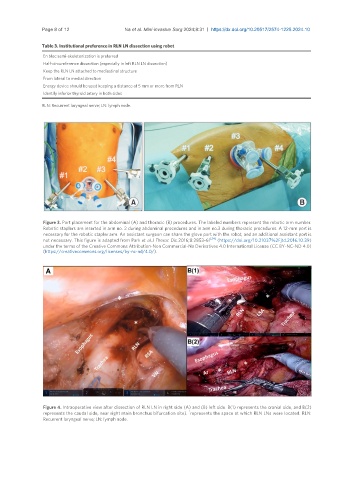
                Figure 3. Port placement for the abdominal (A) and thoracic (B) procedures. The labeled numbers represent the robotic arm number.
                Robotic staplers are inserted in arm no. 2 during abdominal procedures and in arm no.3 during thoracic procedures. A 12-mm port is
                necessary for the robotic stapler arm. An assistant surgeon can share the glove port with the robot, and an additional assistant port is
                not necessary. This figure is adapted from Park et  al. J Thorac  Dis. 2016;8:2853-61 [24]  (https://doi.org/10.21037%2Fjtd.2016.10.39)
                under the terms of the Creative Commons Attribution-Non Commercial-No Derivatives 4.0 International License (CC BY-NC-ND 4.0)
                (https://creativecommons.org/licenses/by-nc-nd/4.0/).


                Figure 4. Intraoperative view after dissection of RLN LN in right side (A) and (B) left side. B(1) represents the cranial side, and B(2)
                                                                 *
                represents the caudal side, near right main bronchus bifurcation site).  represents the space at which RLN LNs were located. RLN:
                Recurrent laryngeal nerve; LN: lymph node.

