


Page 52 - Read Online
P. 52
Kamal et al. J Transl Genet Genom 2024;8:162-85  https://dx.doi.org/10.20517/jtgg.2023.55   Page 176

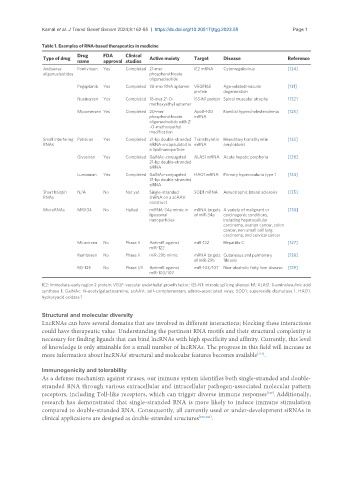
               Table 1. Examples of RNA-based therapeutics in medicine
                           Drug     FDA    Clinical
                Type of drug                       Active moiety  Target    Disease               Reference
                           name     approval studies
                Antisense   Fomivirsen  Yes  Completed 21-mer     IE2 mRNA  Cytomegalovirus       [124]
                oligonucleotides                   phosphorothioate
                                                   oligonucleotide
                           Pegaptanib  Yes  Completed 28-mer RNA aptamer VEGF165   Age-related macular   [131]
                                                                  protein   degeneration
                           Nusinersen  Yes  Completed 18-mer 2′-O-  ISS-N1 protein Spinal muscular atrophy  [132]
                                                   methoxyethyl aptamer
                           Mipomersen Yes  Completed 20-mer       ApoB-100   Familial hypercholesterolemia  [125]
                                                   phosphorothioate   mRNA
                                                   oligonucleotide with 2′
                                                   -O-methoxyethyl
                                                   modification
                Small interfering   Patisiran  Yes  Completed 21-bp double-stranded  Transthyretin  Hereditary transthyretin   [133]
                RNAs                               siRNA encapsulated in  mRNA  amyloidosis
                                                   a lipid nanoparticle
                           Givosiran  Yes  Completed GalNAc-conjugated   ALAS1 mRNA Acute hepatic porphyria  [126]
                                                   21-bp double-stranded
                                                   siRNA
                           Lumasiran  Yes  Completed GalNAc-conjugated   HAO1 mRNA  Primary hyperoxaluria type 1  [134]
                                                   21-bp double-stranded
                                                   siRNA
                Short hairpin   N/A  No    Not yet  Single-stranded   SOD1 mRNA  Amyotrophic lateral sclerosis  [135]
                RNAs                               shRNA on a scAAV
                                                   construct
                MicroRNAs  MRX34    No     Halted  miRNA-34a mimic in   mRNA targets  A variety of malignant or   [130]
                                                   liposomal      of miR-34a  carcinogenic conditions,
                                                   nanoparticles            including hepatocellular
                                                                            carcinoma, ovarian cancer, colon
                                                                            cancer, non-small cell lung
                                                                            carcinoma, and cervical cancer
                           Miravirsen  No  Phase II  AntimiR against   miR-122  Hepatitis C       [127]
                                                   miR-122
                           Remlarsen  No   Phase II  miR-29b mimic  mRNA targets  Cutaneous and pulmonary   [128]
                                                                  of miR-29b  fibrosis
                           RG-125   No     Phase I/II  AntimiR against   miR-103/107  Non-alcoholic fatty liver disease  [129]
                                                   miR-103/107

               IE2: Immediate-early region 2 protein; VEGF: vascular endothelial growth factor; ISS-N1: intronic splicing silencer N1; ALAS1: δ-aminolevulinic acid
               synthase 1; GalNAc: N-acetylgalactosamine; scAAV: self-complementary adeno-associated virus; SOD1: superoxide dismutase 1; HAO1:
               hydroxyacid oxidase 1.


               Structural and molecular diversity
               LncRNAs can have several domains that are involved in different interactions; blocking these interactions
               could have therapeutic value. Understanding the pertinent RNA motifs and their structural complexity is
               necessary for finding ligands that can bind lncRNAs with high specificity and affinity. Currently, this level
               of knowledge is only attainable for a small number of lncRNAs. The progress in this field will increase as
                                                                                        [121]
               more information about lncRNAs' structural and molecular features becomes available .
               Immunogenicity and tolerability
               As a defense mechanism against viruses, our immune system identifies both single-stranded and double-
               stranded RNA through various extracellular and intracellular pathogen-associated molecular pattern
                                                                                           [140]
               receptors, including Toll-like receptors, which can trigger diverse immune responses . Additionally,
               research has demonstrated that single-stranded RNA is more likely to induce immune stimulation
               compared to double-stranded RNA. Consequently, all currently used or under-development siRNAs in
               clinical applications are designed as double-stranded structures [106,141] .

