


Page 72 - Read Online
P. 72
Cheng et al. J. Mater. Inf. 2025, 5, 53  https://dx.doi.org/10.20517/jmi.2025.61  Page 5 of 17


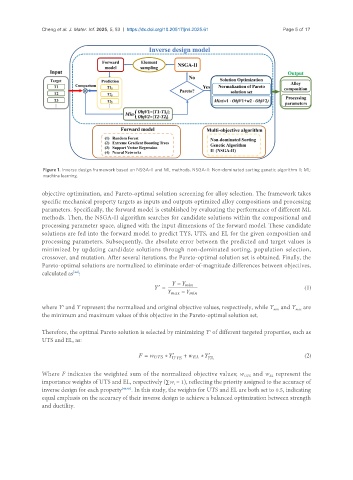
                Figure 1. Inverse design framework based on NSGA-II and ML methods. NSGA-II: Non-dominated sorting genetic algorithm II; ML:
                machine learning.

               objective optimization, and Pareto-optimal solution screening for alloy selection. The framework takes
               specific mechanical property targets as inputs and outputs optimized alloy compositions and processing
               parameters. Specifically, the forward model is established by evaluating the performance of different ML
               methods. Then, the NSGA-II algorithm searches for candidate solutions within the compositional and
               processing parameter space, aligned with the input dimensions of the forward model. These candidate
               solutions are fed into the forward model to predict TYS, UTS, and EL for the given composition and
               processing parameters. Subsequently, the absolute error between the predicted and target values is
               minimized by updating candidate solutions through non-dominated sorting, population selection,
               crossover, and mutation. After several iterations, the Pareto-optimal solution set is obtained. Finally, the
               Pareto-optimal solutions are normalized to eliminate order-of-magnitude differences between objectives,
                          [44]
               calculated as :
                                                              −
                                                        =                                               (1)
                                                      ′
                                                                    −
               where Y′ and Y represent the normalized and original objective values, respectively, while Y  and Y  are
                                                                                                     max
                                                                                             min
               the minimum and maximum values of this objective in the Pareto-optimal solution set.
               Therefore, the optimal Pareto solution is selected by minimizing Y′ of different targeted properties, such as
               UTS and EL, as:

                                                   =           ∗     ′  +         ∗     ′               (2)
                                                           UTS         EL

               Where F indicates the weighted sum of the normalized objective values; w  and w  represent the
                                                                                   UTS
                                                                                            EL
               importance weights of UTS and EL, respectively (∑w = 1), reflecting the priority assigned to the accuracy of
                                                            i
               inverse design for each property [44,45] . In this study, the weights for UTS and EL are both set to 0.5, indicating
               equal emphasis on the accuracy of their inverse design to achieve a balanced optimization between strength
               and ductility.

