


Page 71 - Read Online
P. 71
Page 4 of 17                       Cheng et al. J. Mater. Inf. 2025, 5, 53  https://dx.doi.org/10.20517/jmi.2025.61

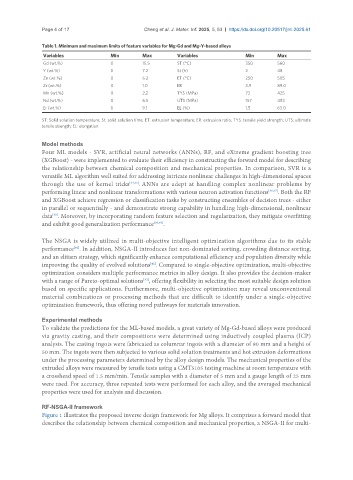
               Table 1. Minimum and maximum limits of feature variables for Mg-Gd and Mg-Y-based alloys
                Variables             Min        Max         Variables              Min        Max
                Gd (wt.%)             0          15.5        ST (°C)                350        560
                Y (wt.%)              0          7.2         St (h)                 2          48
                Zn (wt.%)             0          6.2         ET (°C)                250        505
                Zr (wt.%)             0          1.0         ER                     3.9        89.0
                Mn (wt.%)             0          2.2         TYS (MPa)              73         425
                Nd (wt.%)             0          6.5         UTS (MPa)              157        483
                Er (wt.%)             0          9.1         EL (%)                 1.5        63.0

               ST: Solid solution temperature; St: solid solution time; ET: extrusion temperature; ER: extrusion ratio; TYS: tensile yield strength; UTS: ultimate
               tensile strength; EL: elongation.


               Model methods
               Four ML models - SVR, artificial neural networks (ANNs), RF, and eXtreme gradient boosting tree
               (XGBoost) - were implemented to evaluate their efficiency in constructing the forward model for describing
               the relationship between chemical composition and mechanical properties. In comparison, SVR is a
               versatile ML algorithm well suited for addressing intricate nonlinear challenges in high-dimensional spaces
               through the use of kernel tricks [34,35] . ANNs are adept at handling complex nonlinear problems by
               performing linear and nonlinear transformations with various neuron activation functions [36,37] . Both the RF
               and XGBoost achieve regression or classification tasks by constructing ensembles of decision trees - either
               in parallel or sequentially - and demonstrate strong capability in handling high-dimensional, nonlinear
                   [38]
               data . Moreover, by incorporating random feature selection and regularization, they mitigate overfitting
               and exhibit good generalization performance [39,40] .

               The NSGA is widely utilized in multi-objective intelligent optimization algorithms due to its stable
               performance . In addition, NSGA-II introduces fast non-dominated sorting, crowding distance sorting,
                          [41]
               and an elitism strategy, which significantly enhance computational efficiency and population diversity while
               improving the quality of evolved solutions . Compared to single-objective optimization, multi-objective
                                                    [42]
               optimization considers multiple performance metrics in alloy design. It also provides the decision-maker
               with a range of Pareto-optimal solutions , offering flexibility in selecting the most suitable design solution
                                                 [43]
               based on specific applications. Furthermore, multi-objective optimization may reveal unconventional
               material combinations or processing methods that are difficult to identify under a single-objective
               optimization framework, thus offering novel pathways for materials innovation.


               Experimental methods
               To validate the predictions for the ML-based models, a great variety of Mg-Gd-based alloys were produced
               via gravity casting, and their compositions were determined using inductively coupled plasma (ICP)
               analysis. The casting ingots were fabricated as columnar ingots with a diameter of 80 mm and a height of
               50 mm. The ingots were then subjected to various solid solution treatments and hot extrusion deformations
               under the processing parameters determined by the alloy design models. The mechanical properties of the
               extruded alloys were measured by tensile tests using a CMT5105 testing machine at room temperature with
               a crosshead speed of 1.5 mm/min. Tensile samples with a diameter of 5 mm and a gauge length of 25 mm
               were used. For accuracy, three repeated tests were performed for each alloy, and the averaged mechanical
               properties were used for analysis and discussion.

               RF-NSGA-II framework
               Figure 1 illustrates the proposed inverse design framework for Mg alloys. It comprises a forward model that
               describes the relationship between chemical composition and mechanical properties, a NSGA-II for multi-

