


Page 217 - Read Online
P. 217
Page 20 of 25                                                    Wang et al. J. Mater. Inf. 2026, 6, 16


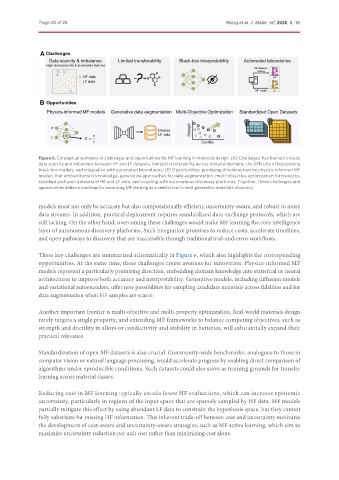
               Figure 6. Conceptual summary of challenges and opportunities for MF learning in materials design. (A) Challenges: key barriers include
               data scarcity and imbalance between HF and LF datasets, limited transferability across material domains, the difficulty of interpreting
               black-box models, and integration with automated laboratories; (B) Opportunities: promising directions involve physics-informed MF
               models that embed domain knowledge, generative approaches for data augmentation, multi-objective optimization frameworks,
               standardized open datasets of HF and LF data, and coupling with autonomous discovery platforms. Together, these challenges and
               opportunities define a roadmap for advancing MF learning as a central tool in next-generation materials discovery.


               models must not only be accurate but also computationally efficient, uncertainty-aware, and robust to noisy
               data streams. In addition, practical deployment requires standardized data-exchange protocols, which are
               still lacking. On the other hand, overcoming these challenges would make MF learning the core intelligence
               layer of autonomous discovery platforms. Such integration promises to reduce costs, accelerate timelines,
               and open pathways to discovery that are inaccessible through traditional trial-and-error workflows.


               These key challenges are summarized schematically in Figure 6, which also highlights the corresponding
               opportunities. At the same time, these challenges create avenues for innovation. Physics-informed MF
               models represent a particularly promising direction, embedding domain knowledge into statistical or neural
               architectures to improve both accuracy and interpretability. Generative models, including diffusion models
               and variational autoencoders, offer new possibilities for sampling candidate materials across fidelities and for
               data augmentation when HF samples are scarce.

               Another important frontier is multi-objective and multi-property optimization. Real-world materials design
               rarely targets a single property, and extending MF frameworks to balance competing objectives, such as
               strength and ductility in alloys or conductivity and stability in batteries, will substantially expand their
               practical relevance.


               Standardization of open MF datasets is also crucial. Community-wide benchmarks, analogous to those in
               computer vision or natural language processing, would accelerate progress by enabling direct comparison of
               algorithms under eproducible conditions. Such datasets could also serve as training grounds for transfer
               learning across material classes.

               Reducing cost in MF learning typically entails fewer HF evaluations, which can increase epistemic
               uncertainty, particularly in regions of the input space that are sparsely sampled by HF data. MF models
               partially mitigate this effect by using abundant LF data to constrain the hypothesis space, but they cannot
               fully substitute for missing HF information. This inherent trade-off between cost and uncertainty motivates
               the development of cost-aware and uncertainty-aware strategies, such as MF active learning, which aim to
               maximize uncertainty reduction per unit cost rather than minimizing cost alone.

