


Page 214 - Read Online
P. 214
Wang et al. J. Mater. Inf. 2026, 6, 16                                           Page 17 of 25


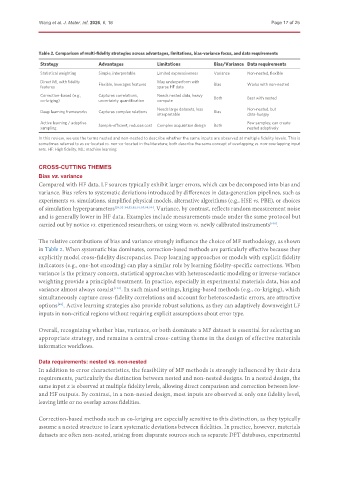
               Table 2. Comparison of multi-fidelity strategies across advantages, limitations, bias-variance focus, and data requirements
               Strategy             Advantages          Limitations         Bias/Variance Data requirements

               Statistical weighting  Simple, interpretable  Limited expressiveness  Variance  Non-nested, flexible
               Direct ML with fidelity  Flexible, leverages features  May underperform with  Bias  Works with non-nested
               features                                 sparse HF data
               Correction-based (e.g.,  Captures correlations,  Needs nested data, heavy  Both  Best with nested
               co-kriging)          uncertainty quantification  compute
                                                        Needs large datasets, less      Non-nested, but
               Deep learning frameworks  Captures complex relations         Bias
                                                        interpretable                   data-hungry
               Active learning / adaptive  Sample-efficient, reduces cost  Complex acquisition design  Both  Few samples; can create
               sampling                                                                 nested adaptively
               In this review, we use the terms nested and non-nested to describe whether the same inputs are observed at multiple fidelity levels. This is
               sometimes referred to as co-located vs. non-co-located in the literature; both describe the same concept of overlapping vs. non-overlapping input
               sets. HF: High fidelity; ML: machine learning.


               CROSS-CUTTING THEMES
               Bias vs. variance
               Compared with HF data, LF sources typically exhibit larger errors, which can be decomposed into bias and
               variance. Bias refers to systematic deviations introduced by differences in data-generation pipelines, such as
               experiments vs. simulations, simplified physical models, alternative algorithms (e.g., HSE vs. PBE), or choices
               of simulation hyperparameters [29,32-34,52,82,91,95,98,99] . Variance, by contrast, reflects random measurement noise
               and is generally lower in HF data. Examples include measurements made under the same protocol but
               carried out by novice vs. experienced researchers, or using worn vs. newly calibrated instruments .
                                                                                                [100]

               The relative contributions of bias and variance strongly influence the choice of MF methodology, as shown
               in Table 2. When systematic bias dominates, correction-based methods are particularly effective because they
               explicitly model cross-fidelity discrepancies. Deep learning approaches or models with explicit fidelity
               indicators (e.g., one-hot encoding) can play a similar role by learning fidelity-specific corrections. When
               variance is the primary concern, statistical approaches with heteroscedastic modeling or inverse-variance
               weighting provide a principled treatment. In practice, especially in experimental materials data, bias and
               variance almost always coexist [101] . In such mixed settings, kriging-based methods (e.g., co-kriging), which
               simultaneously capture cross-fidelity correlations and account for heteroscedastic errors, are attractive
               options . Active learning strategies also provide robust solutions, as they can adaptively downweight LF
                     [48]
               inputs in non-critical regions without requiring explicit assumptions about error type.

               Overall, recognizing whether bias, variance, or both dominate a MF dataset is essential for selecting an
               appropriate strategy, and remains a central cross-cutting theme in the design of effective materials
               informatics workflows.


               Data requirements: nested vs. non-nested
               In addition to error characteristics, the feasibility of MF methods is strongly influenced by their data
               requirements, particularly the distinction between nested and non-nested designs. In a nested design, the
               same input x is observed at multiple fidelity levels, allowing direct comparison and correction between low-
               and HF outputs. By contrast, in a non-nested design, most inputs are observed at only one fidelity level,
               leaving little or no overlap across fidelities.


               Correction-based methods such as co-kriging are especially sensitive to this distinction, as they typically
               assume a nested structure to learn systematic deviations between fidelities. In practice, however, materials
               datasets are often non-nested, arising from disparate sources such as separate DFT databases, experimental

