


Page 211 - Read Online
P. 211
Page 14 of 25                                                    Wang et al. J. Mater. Inf. 2026, 6, 16


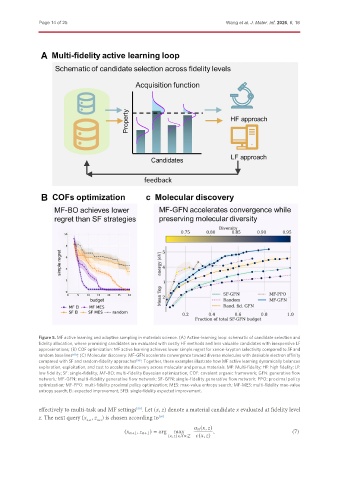
               Figure 5. MF active learning and adaptive sampling in materials science. (A) Active-learning loop: schematic of candidate selection and
               fidelity allocation, where promising candidates are evaluated with costly HF methods and less valuable candidates with inexpensive LF
               approximations; (B) COF optimization: MF active learning achieves lower simple regret for xenon-krypton selectivity compared to SF and
               random baselines [60] ; (C) Molecular discovery: MF-GFN accelerate convergence toward diverse molecules with desirable electron affinity
               compared with SF and random-fidelity approaches [96] . Together, these examples illustrate how MF active learning dynamically balances
               exploration, exploitation, and cost to accelerate discovery across molecular and porous materials. MF: Multi-fidelity; HF: high fidelity; LF:
               low fidelity; SF: single-fidelity; MF-BO: multi-fidelity Bayesian optimization; COF: covalent organic framework; GFN: generative flow
               network; MF-GFN: multi-fidelity generative flow network; SF-GFN: single-fidelity generative flow network; PPO: proximal policy
               optimization; MF-PPO: multi-fidelity proximal policy optimization; MES: max-value entropy search; MF-MES: multi-fidelity max-value
               entropy search; EI: expected improvement; SFEI: single-fidelity expected improvement.


               effectively to multi-task and MF settings . Let (x, z) denote a material candidate x evaluated at fidelity level
                                                 [50]
               z. The next query (x , z ) is chosen according to [50]
                                   n+1
                               n+1
                                                                     U = (G, I)
                                             (G =+1 , I =+1 ) = arg  max    ,                           (7)
                                                            (G,I)∈X×Z 2(G, I)

