


Page 208 - Read Online
P. 208
Wang et al. J. Mater. Inf. 2026, 6, 16                                           Page 11 of 25


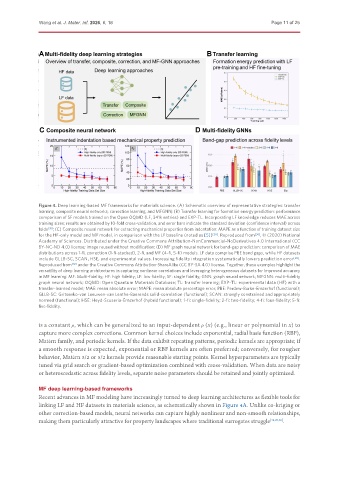
               Figure 4. Deep learning-based MF frameworks for materials science. (A) Schematic overview of representative strategies: transfer
               learning, composite neural networks, correction learning, and MFGNN; (B) Transfer learning for formation energy prediction: performance
               comparison of SF models trained on the Open OQMD (LF, 341k entries) and EXP-TL. Incorporating LF knowledge reduces MAE across
               training sizes; results are obtained by 10-fold cross-validation, and error bars indicate the standard deviation (confidence interval) across
               folds [35] ; (C) Composite neural network for extracting mechanical properties from indentation: MAPE as a function of training dataset size
               for the HF-only model and MF model, in comparison with the LF baseline (noted as [5])  [30] . Reproduced from  [30] , © (2020) National
               Academy of Sciences. Distributed under the Creative Commons Attribution-NonCommercial-NoDerivatives 4.0 International (CC
               BY-NC-ND 4.0) license; image reused without modification; (D) MF graph neural network for band-gap prediction: comparison of MAE
               distributions across 1-fi, correction (1-fi-stacked), 2-fi, and MF (4-fi, 5-fi) models. LF data comprise PBE band gaps, while HF datasets
               include GLLB-SC, SCAN, HSE, and experimental values. Increasing fidelity integration systematically lowers prediction error  [29] .
               Reproduced from [29]  under the Creative Commons Attribution-ShareAlike (CC BY-SA 4.0) license. Together, these examples highlight the
               versatility of deep learning architectures in capturing nonlinear correlations and leveraging heterogeneous datasets for improved accuracy
               in MF learning. MF: Multi-fidelity; HF: high fidelity; LF: low fidelity; SF: single fidelity; GNN: graph neural network; MFGNN: multi-fidelity
               graph neural network; OQMD: Open Quantum Materials Database; TL: transfer learning; EXP-TL: experimental data (HF) with a
               transfer-learned model; MAE: mean absolute error; MAPE: mean absolute percentage error; PBE: Perdew-Burke-Ernzerhof (functional);
               GLLB-SC: Gritsenko-van Leeuwen-van Lenthe-Baerends solid-correlation (functional); SCAN: strongly constrained and appropriately
               normed (functional); HSE: Heyd-Scuseria-Ernzerhof (hybrid functional); 1-fi: single-fidelity; 2-fi: two-fidelity; 4-fi: four-fidelity; 5-fi:
               five-fidelity.


               is a constant ρ, which can be generalized to an input-dependent ρ (x) (e.g., linear or polynomial in x) to
               capture more complex corrections. Common kernel choices include exponential, radial basis function (RBF),
               Matérn family, and periodic kernels. If the data exhibit repeating patterns, periodic kernels are appropriate; if
               a smooth response is expected, exponential or RBF kernels are often preferred; conversely, for rougher
               behavior, Matérn 3/2 or 5/2 kernels provide reasonable starting points. Kernel hyperparameters are typically
               tuned via grid search or gradient-based optimization combined with cross-validation. When data are noisy
               or heteroscedastic across fidelity levels, separate noise parameters should be retained and jointly optimized.

               MF deep learning-based frameworks
               Recent advances in MF modeling have increasingly turned to deep learning architectures as flexible tools for
               linking LF and HF datasets in materials science, as schematically shown in Figure 4A. Unlike co-kriging or
               other correction-based models, neural networks can capture highly nonlinear and non-smooth relationships,
               making them particularly attractive for property landscapes where traditional surrogates struggle [49,85,86] .

