


Page 203 - Read Online
P. 203
Page 6 of 25                                                     Wang et al. J. Mater. Inf. 2026, 6, 16


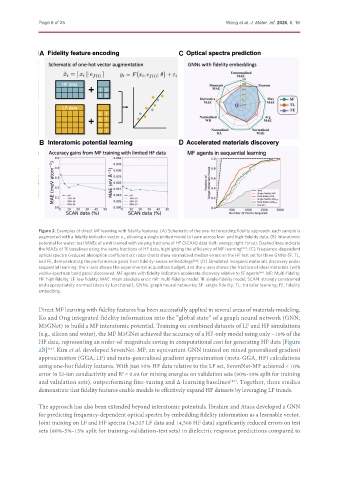
               Figure 2. Examples of direct MF learning with fidelity features. (A) Schematic of the one-hot encoding fidelity approach: each sample is
               augmented with a fidelity indicator vector e  f , allowing a single unified model to learn across low- and high-fidelity data; (B) Interatomic
               potential for water: test MAEs of a mfi trained with varying fractions of HF (SCAN) data (left: energy; right: force). Dashed lines indicate
               the MAEs of 1fi baselines using the same fractions of HF data, highlighting the efficiency of MF learning [39] ; (C) Frequency-dependent
               optical spectra (reduced absorption coefficient α): radar charts show normalized median errors on the HF test set for three GNNs-SF, TL,
               and FE, demonstrating the performance gains from fidelity-aware embeddings [66] ; (D) Simulated inorganic materials discovery under
               sequential learning: the x-axis shows the experimental acquisition budget, and the y-axis shows the fraction of ideal materials (with
               visible-spectrum band gaps) discovered. MF agents with fidelity indicators accelerate discovery relative to SF agents [47] . MF: Multi-fidelity;
               HF: high fidelity; LF: low fidelity; MAE: mean absolute error; mfi: multi-fidelity model; 1fi: single-fidelity model; SCAN: strongly constrained
               and appropriately normed (density functional); GNNs: graph neural networks; SF: single fidelity; TL: transfer learning; FE: fidelity
               embedding.


               Direct MF learning with fidelity features has been successfully applied in several areas of materials modeling.
               Ko and Ong integrated fidelity information into the “global state” of a graph neural network (GNN;
               M3GNet) to build a MF interatomic potential. Training on combined datasets of LF and HF simulations
               (e.g., silicon and water), the MF M3GNet achieved the accuracy of a HF-only model using only ~10% of the
               HF data, representing an order-of-magnitude saving in computational cost for generating HF data [Figure
               2B] . Kim et al. developed SevenNet-MF, an equivariant GNN trained on mixed generalized gradient
                  [39]
               approximation (GGA, LF) and meta-generalized gradient approximation (meta-GGA, HF) calculations
               using one-hot fidelity features. With just 10% HF data relative to the LF set, SevenNet-MF achieved < 10%
               error in Li-ion conductivity and R  ≈ 0.98 for mixing energies on validation sets (90%-10% split for training
                                            2
               and validation sets), outperforming fine-tuning and ∆-learning baselines . Together, these studies
                                                                                  [40]
               demonstrate that fidelity features enable models to effectively expand HF datasets by leveraging LF trends.

               The approach has also been extended beyond interatomic potentials. Ibrahim and Ataca developed a GNN
               for predicting frequency-dependent optical spectra by embedding fidelity information as a learnable vector.
               Joint training on LF and HF spectra (34,327 LF data and 14,560 HF data) significantly reduced errors on test
               sets (80%-5%-15% split for training-validation-test sets) in dielectric response predictions compared to

