


Page 200 - Read Online
P. 200
Wang et al. J. Mater. Inf. 2026, 6, 16                                            Page 3 of 25


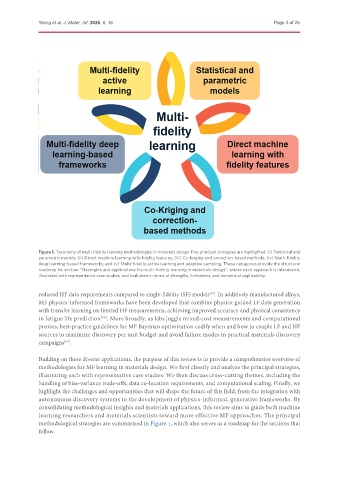
               Figure 1. Taxonomy of multi-fidelity learning methodologies in materials design. Five principal strategies are highlighted: (i) Statistical and
               parametric models; (ii) Direct machine learning with fidelity features; (iii) Co-Kriging and correction-based methods; (iv) Multi-fidelity
               deep learning-based frameworks; and (v) Multi-fidelity active learning and adaptive sampling. These categories provide the structural
               roadmap for section “Strategies and applications for multi-fidelity learning in materials design”, where each approach is introduced,
               illustrated with representative case studies, and evaluated in terms of strengths, limitations, and domains of applicability.

               reduced HF data requirements compared to single-fidelity (SF) models . In additively manufactured alloys,
                                                                           [58]
               MF physics-informed frameworks have been developed that combine physics-guided LF data generation
               with transfer learning on limited HF measurements, achieving improved accuracy and physical consistency
               in fatigue life prediction . More broadly, as labs juggle mixed-cost measurements and computational
                                    [59]
               proxies, best-practice guidelines for MF Bayesian optimization codify when and how to couple LF and HF
               sources to maximize discovery per unit budget and avoid failure modes in practical materials discovery
               campaigns .
                        [60]

               Building on these diverse applications, the purpose of this review is to provide a comprehensive overview of
               methodologies for MF learning in materials design. We first classify and analyze the principal strategies,
               illustrating each with representative case studies. We then discuss cross-cutting themes, including the
               handling of bias-variance trade-offs, data co-location requirements, and computational scaling. Finally, we
               highlight the challenges and opportunities that will shape the future of this field, from the integration with
               autonomous discovery systems to the development of physics-informed, generative frameworks. By
               consolidating methodological insights and materials applications, this review aims to guide both machine
               learning researchers and materials scientists toward more effective MF approaches. The principal
               methodological strategies are summarized in Figure 1, which also serves as a roadmap for the sections that
               follow.

