


Page 205 - Read Online
P. 205
Page 8 of 25                                                     Wang et al. J. Mater. Inf. 2026, 6, 16


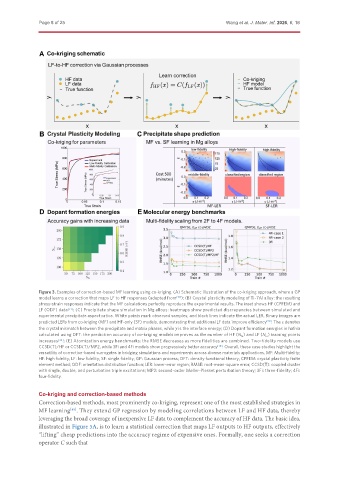
               Figure 3. Examples of correction-based MF learning using co-kriging. (A) Schematic illustration of the co-kriging approach, where a GP
               model learns a correction that maps LF to HF responses (adapted from [71] ); (B) Crystal plasticity modeling of Ti-7Al alloy: the resulting
               stress-strain responses indicate that the MF calculations perfectly reproduce the experimental results. The inset shows HF (CPFEM) and
               LF (ODF) data [77] ; (C) Precipitate shape simulation in Mg alloys: heatmaps show predicted discrepancies between simulated and
               experimental precipitate aspect ratios. White points mark observed samples, and black lines indicate the actual LER. Binary images are
               predicted LERs from co-kriging (MF) and HF-only (SF) models, demonstrating that additional LF data improve efficiency [28] . The ε denotes
               the crystal mismatch between the precipitate and matrix phases, while γ is the interface energy; (D) Dopant formation energies in hafnia
               calculated using DFT: the prediction accuracy of co-kriging models improves as the number of HF (N hi ) and LF (N lo ) training points
               increases [34] ; (E) Atomization energy benchmarks: the RMSE decreases as more fidelities are combined. Two-fidelity models use
               CCSD(T)/HF or CCSD(T)/MP2, while 3Fi and 4Fi models show progressively better accuracy [78] . Overall, these case studies highlight the
               versatility of correction-based surrogates in bridging simulations and experiments across diverse materials applications. MF: Multi-fidelity;
               HF: high fidelity; LF: low fidelity; SF: single fidelity; GP: Gaussian process; DFT: density functional theory; CPFEM: crystal plasticity finite
               element method; ODF: orientation distribution function; LER: lower-error region; RMSE: root-mean-square error; CCSD(T): coupled cluster
               with single, double, and perturbative triple excitations; MP2: second-order Møller-Plesset perturbation theory; 3Fi: three-fidelity; 4Fi:
               four-fidelity.


               Co-kriging and correction-based methods
               Correction-based methods, most prominently co-kriging, represent one of the most established strategies in
               MF learning . They extend GP regression by modeling correlations between LF and HF data, thereby
                          [48]
               leveraging the broad coverage of inexpensive LF data to complement the accuracy of HF data. The basic idea,
               illustrated in Figure 3A, is to learn a statistical correction that maps LF outputs to HF outputs, effectively
               “lifting” cheap predictions into the accuracy regime of expensive ones. Formally, one seeks a correction
               operator C such that

