


Page 212 - Read Online
P. 212
Wang et al. J. Mater. Inf. 2026, 6, 16                                           Page 15 of 25


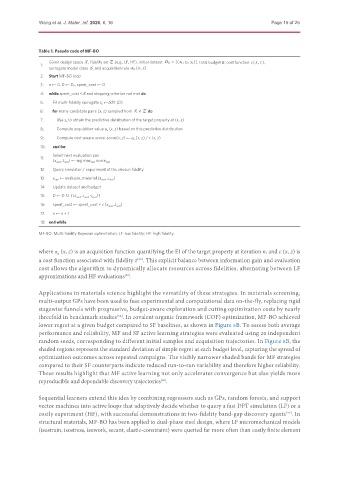
               Table 1. Pseudo code of MF-BO
                  Given design space  , fidelity set      (e.g., LF, HF), initial dataset                                    , total budget B, cost function               ,
                                        Z
                                                             0 = {(G 8 , I 8 , H 8 )}
                               X
                                                                                         2(G, I)
               1:
                                 S
                  surrogate model class     , and acquisition rule U = (G, I)
               2:  Start MF-BO loop
               3:  n ← 0, D ← D0, spent_cost ← 0
               4:  while spent_cost < B and stopping criterion not met do
               5:    Fit multi-fidelity surrogate s n  ←  .fit (D)
                                       S
               6:    for many candidate pairs (x, z) sampled from             do
                                                X × Z
               7:     Use s n  to obtain the predictive distribution of the target property at (x, z)
               8:     Compute acquisition value α n  (x, z) based on this predictive distribution
               9:     Compute cost-aware score: score(x, z) ← α n  (x, z) / c (x, z)
               10:   end for
                    Select next evaluation pair
               11:
                      (x next , z next ) ← arg max (x,z)  score (x,z)
               12:   Query simulator / experiment at the chosen fidelity
               13:   y next  ← evaluate_material (x next , z next )
               14:   Update dataset and budget
               15:   D ← D ∪ {(x next , z next , y next )}
               16:   spent_cost ← spent_cost + c (x next , z next )
               17:   n ← n + 1
               18: end while

               MF-BO: Multi-fidelity Bayesian optimization; LF: low fidelity; HF: high fidelity.

               where α  (x, z) is an acquisition function quantifying the EI of the target property at iteration n, and c (x, z) is
                     n
               a cost function associated with fidelity z . This explicit balance between information gain and evaluation
                                                 [50]
               cost allows the algorithm to dynamically allocate resources across fidelities, alternating between LF
               approximations and HF evaluations .
                                             [50]
               Applications in materials science highlight the versatility of these strategies. In materials screening,
               multi-output GPs have been used to fuse experimental and computational data on-the-fly, replacing rigid
               stagewise funnels with progressive, budget-aware exploration and cutting optimization costs by nearly
               threefold in benchmark studies . In covalent organic framework (COF) optimization, MF-BO achieved
                                          [54]
               lower regret at a given budget compared to SF baselines, as shown in Figure 5B. To assess both average
               performance and reliability, MF and SF active learning strategies were evaluated using 20 independent
               random seeds, corresponding to different initial samples and acquisition trajectories. In Figure 5B, the
               shaded regions represent the standard deviation of simple regret at each budget level, capturing the spread of
               optimization outcomes across repeated campaigns. The visibly narrower shaded bands for MF strategies
               compared to their SF counterparts indicate reduced run-to-run variability and therefore higher reliability.
               These results highlight that MF active learning not only accelerates convergence but also yields more
               reproducible and dependable discovery trajectories .
                                                         [60]

               Sequential learners extend this idea by combining regressors such as GPs, random forests, and support
               vector machines into active loops that adaptively decide whether to query a fast DFT simulation (LF) or a
               costly experiment (HF), with successful demonstrations in two-fidelity band-gap discovery agents . In
                                                                                                     [47]
               structural materials, MF-BO has been applied to dual-phase steel design, where LF micromechanical models
               (isostrain, isostress, isowork, secant, elastic-constraint) were queried far more often than costly finite element

