


Page 184 - Read Online
P. 184
Hei et al. J. Mater. Inf. 2026, 6, 15                                             Page 9 of 22


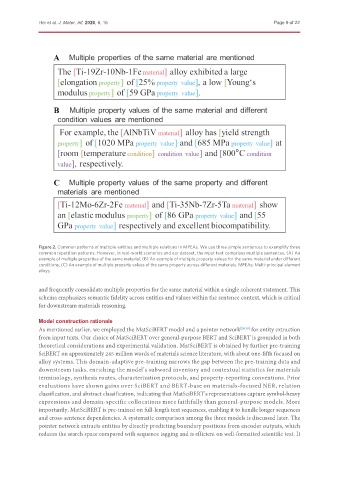
               Figure 2. Common patterns of multiple entities and multiple relations in MPEAs. We use three simple sentences to exemplify three
               common repetition patterns. However, in real-world scenarios and our dataset, the input text comprises multiple sentences. (A) An
               example of multiple properties of the same material; (B) An example of multiple property values for the same material under different
               conditions; (C) An example of multiple property values of the same property across different materials. MPEAs: Multi-principal element
               alloys.

               and frequently consolidate multiple properties for the same material within a single coherent statement. This
               schema emphasizes semantic fidelity across entities and values within the sentence context, which is critical
               for downstream materials reasoning.


               Model construction rationale
               As mentioned earlier, we employed the MatSciBERT model and a pointer network [28,30]  for entity extraction
               from input texts. Our choice of MatSciBERT over general-purpose BERT and SciBERT is grounded in both
               theoretical considerations and experimental validation. MatSciBERT is obtained by further pre-training
               SciBERT on approximately 285 million words of materials science literature, with about one-fifth focused on
               alloy systems. This domain-adaptive pre-training narrows the gap between the pre-training data and
               downstream tasks, enriching the model’s subword inventory and contextual statistics for materials
               terminology, synthesis routes, characterization protocols, and property-reporting conventions. Prior
               evaluations have shown gains over SciBERT and BERT-base on materials-focused NER, relation
               classification, and abstract classification, indicating that MatSciBERT’s representations capture symbol-heavy
               expressions and domain-specific collocations more faithfully than general-purpose models. More
               importantly, MatSciBERT is pre-trained on full-length text sequences, enabling it to handle longer sequences
               and cross-sentence dependencies. A systematic comparison among the three models is discussed later. The
               pointer network extracts entities by directly predicting boundary positions from encoder outputs, which
               reduces the search space compared with sequence tagging and is efficient on well-formatted scientific text. It

