


Page 185 - Read Online
P. 185
Page 10 of 22                                                      Hei et al. J. Mater. Inf. 2026, 6, 15


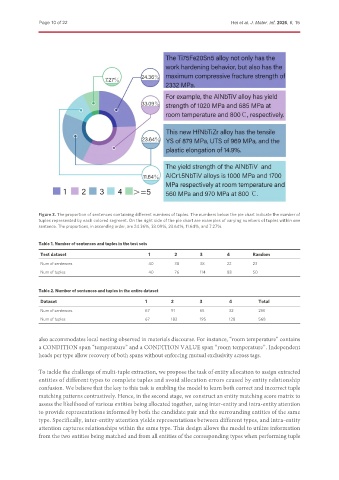
               Figure 3. The proportion of sentences containing different numbers of tuples. The numbers below the pie chart indicate the number of
               tuples represented by each colored segment. On the right side of the pie chart are examples of varying numbers of tuples within one
               sentence. The proportions, in ascending order, are 24.36%, 33.09%, 23.64%, 11.64%, and 7.27%.


               Table 1. Number of sentences and tuples in the test sets
               Test dataset                          1        2        3         4        Random
               Num of sentences                      40       38       38        22       23
               Num of tuples                         40       76       114       88       50


               Table 2. Number of sentences and tuples in the entire dataset
               Dataset                              1        2         3         4          Total

               Num of sentences                     67       91        65        32         255
               Num of tuples                        67       182       195       128        568


               also accommodates local nesting observed in materials discourse. For instance, “room temperature” contains
               a CONDITION span “temperature” and a CONDITION VALUE span “room temperature”. Independent
               heads per type allow recovery of both spans without enforcing mutual exclusivity across tags.

               To tackle the challenge of multi-tuple extraction, we propose the task of entity allocation to assign extracted
               entities of different types to complete tuples and avoid allocation errors caused by entity relationship
               confusion. We believe that the key to this task is enabling the model to learn both correct and incorrect tuple
               matching patterns contrastively. Hence, in the second stage, we construct an entity matching score matrix to
               assess the likelihood of various entities being allocated together, using inter-entity and intra-entity attention
               to provide representations informed by both the candidate pair and the surrounding entities of the same
               type. Specifically, inter-entity attention yields representations between different types, and intra-entity
               attention captures relationships within the same type. This design allows the model to utilize information
               from the two entities being matched and from all entities of the corresponding types when performing tuple

