


Page 181 - Read Online
P. 181
Page 6 of 22                                                       Hei et al. J. Mater. Inf. 2026, 6, 15


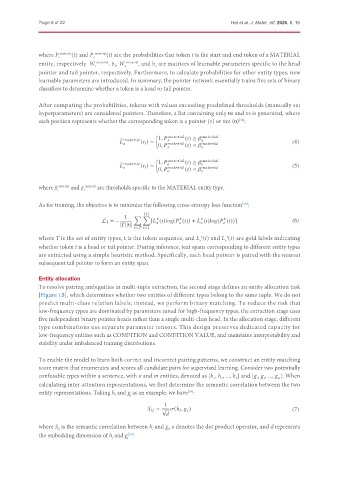
               where P s material (t) and P e material (t) are the probabilities that token t is the start and end token of a MATERIAL
               entity, respectively. W s material , b , W e material , and b  are matrices of learnable parameters specific to the head
                                                        e
                                         s
               pointer and tail pointer, respectively. Furthermore, to calculate probabilities for other entity types, new
               learnable parameters are introduced. In summary, the pointer network essentially trains five sets of binary
               classifiers to determine whether a token is a head or tail pointer.


               After computing the probabilities, tokens with values exceeding predefined thresholds (manually set
               hyperparameters) are considered pointers. Therefore, a list containing only 0s and 1s is generated, where
               each position represents whether the corresponding token is a pointer (1) or not (0) :
                                                                                     [28]
                                                        {   material    material
                                           ˆ material
                                                  (      ) =  1,       material (  ) ≥       material   (4)
                                                         0,
                                                                  (  ) <


                                                        {   material    material
                                           ˆ material
                                                  (      ) =  1,       material (  ) ≥       material   (5)
                                                         0,
                                                                  (  ) <


               where β s material  and β e material  are thresholds specific to the MATERIAL entity type.
               As for training, the objective is to minimize the following cross-entropy loss function :
                                                                                      [29]
                                                    |t|
                                             1  ∑ ∑
                                     L 1 = −          [   (  )log(   (  )) +    (  )log(   (  ))]       (6)


                                           |  ||t|
                                                  ∈     =1
               where T is the set of entity types, t is the token sequence, and L (t) and L (t) are gold labels indicating
                                                                        τ
                                                                                 τ
                                                                                e
                                                                       s
               whether token t is a head or tail pointer. During inference, text spans corresponding to different entity types
               are extracted using a simple heuristic method. Specifically, each head pointer is paired with the nearest
               subsequent tail pointer to form an entity span.
               Entity allocation
               To resolve pairing ambiguities in multi-tuple extraction, the second stage defines an entity allocation task
               [Figure 1B], which determines whether two entities of different types belong to the same tuple. We do not
               predict multi-class relation labels; instead, we perform binary matching. To reduce the risk that
               low-frequency types are dominated by parameters tuned for high-frequency types, the extraction stage uses
               five independent binary pointer heads rather than a single multi-class head. In the allocation stage, different
               type combinations use separate parameter tensors. This design preserves dedicated capacity for
               low-frequency entities such as CONDITION and CONDITION VALUE, and maintains interpretability and
               stability under imbalanced training distributions.


               To enable the model to learn both correct and incorrect pairing patterns, we construct an entity matching
               score matrix that enumerates and scores all candidate pairs for supervised learning. Consider two potentially
               confusable types within a sentence, with n and m entities, denoted as [h , h , ..., h ] and [g , g , ..., g ]. When
                                                                               2
                                                                            1
                                                                                                  m
                                                                                    n
                                                                                           1
                                                                                              2
               calculating inter-attention representations, we first determine the semantic correlation between the two
               entity representations. Taking h and g as an example, we have :
                                                                   [29]
                                         i
                                               j
                                                           1
                                                              = √   (ℎ    ,       )                     (7)

               where S  is the semantic correlation between h and g, σ denotes the dot product operator, and d represents
                                                       i
                     ij
                                                            j
               the embedding dimension of h and g .
                                              [29]
                                        i
                                              j

