


Page 179 - Read Online
P. 179
Page 4 of 22                                                       Hei et al. J. Mater. Inf. 2026, 6, 15


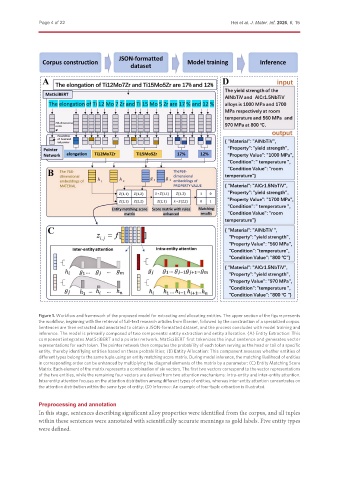
               Figure 1. Workflow and framework of the proposed model for extracting and allocating entities. The upper section of the figure presents
               the workflow, beginning with the retrieval of full-text research articles from Elsevier, followed by the construction of a specialized corpus.
               Sentences are then extracted and annotated to obtain a JSON-formatted dataset, and the process concludes with model training and
               inference. The model is primarily composed of two components: entity extraction and entity allocation. (A) Entity Extraction: This
               component integrates MatSciBERT and a pointer network. MatSciBERT first tokenizes the input sentence and generates vector
               representations for each token. The pointer network then computes the probability of each token serving as the head or tail of a specific
               entity, thereby identifying entities based on these probabilities; (B) Entity Allocation: This component assesses whether entities of
               different types belong to the same tuple using an entity matching score matrix. During model inference, the matching likelihood of entities
               in corresponding order can be enhanced by multiplying the diagonal elements of the matrix by a parameter; (C) Entity Matching Score
               Matrix: Each element of the matrix represents a combination of six vectors. The first two vectors correspond to the vector representations
               of the two entities, while the remaining four vectors are derived from two attention mechanisms: intra-entity and inter-entity attention.
               Intra-entity attention focuses on the attention distribution among different types of entities, whereas inter-entity attention concentrates on
               the attention distribution within the same type of entity; (D) Inference: An example of four-tuple extraction is illustrated.


               Preprocessing and annotation
               In this stage, sentences describing significant alloy properties were identified from the corpus, and all tuples
               within these sentences were annotated with scientifically accurate meanings as gold labels. Five entity types
               were defined.

