


Page 169 - Read Online
P. 169
Wang et al. J. Mater. Inf. 2026, 6, 13                                           Page 13 of 19


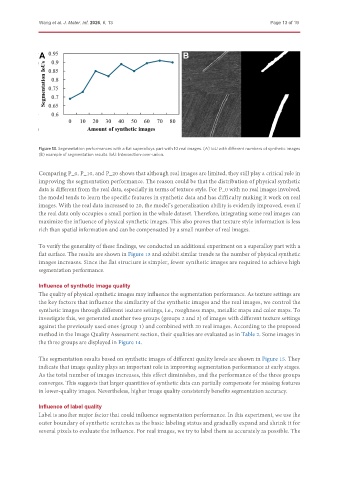
               Figure 13. Segmentation performances with a flat superalloys part with 10 real images. (A) IoU with different numbers of synthetic images
               (B) example of segmentation results. IoU: Intersection-over-union.


               Comparing P_0, P_10, and P_20 shows that although real images are limited, they still play a critical role in
               improving the segmentation performance. The reason could be that the distribution of physical synthetic
               data is different from the real data, especially in terms of texture style. For P_0 with no real images involved,
               the model tends to learn the specific features in synthetic data and has difficulty making it work on real
               images. With the real data increased to 20, the model’s generalization ability is evidently improved, even if
               the real data only occupies a small portion in the whole dataset. Therefore, integrating some real images can
               maximize the influence of physical synthetic images. This also proves that texture style information is less
               rich than spatial information and can be compensated by a small number of real images.


               To verify the generality of these findings, we conducted an additional experiment on a superalloy part with a
               flat surface. The results are shown in Figure 13 and exhibit similar trends as the number of physical synthetic
               images increases. Since the flat structure is simpler, fewer synthetic images are required to achieve high
               segmentation performance.


               Influence of synthetic image quality
               The quality of physical synthetic images may influence the segmentation performance. As texture settings are
               the key factors that influence the similarity of the synthetic images and the real images, we control the
               synthetic images through different texture settings, i.e., roughness maps, metallic maps and color maps. To
               investigate this, we generated another two groups (groups 2 and 3) of images with different texture settings
               against the previously used ones (group 1) and combined with 20 real images. According to the proposed
               method in the Image Quality Assessment section, their qualities are evaluated as in Table 2. Some images in
               the three groups are displayed in Figure 14.


               The segmentation results based on synthetic images of different quality levels are shown in Figure 15. They
               indicate that image quality plays an important role in improving segmentation performance at early stages.
               As the total number of images increases, this effect diminishes, and the performance of the three groups
               converges. This suggests that larger quantities of synthetic data can partially compensate for missing features
               in lower-quality images. Nevertheless, higher image quality consistently benefits segmentation accuracy.

               Influence of label quality
               Label is another major factor that could influence segmentation performance. In this experiment, we use the
               outer boundary of synthetic scratches as the basic labeling status and gradually expand and shrink it for
               several pixels to evaluate the influence. For real images, we try to label them as accurately as possible. The

