


Page 172 - Read Online
P. 172
Page 16 of 19                                                    Wang et al. J. Mater. Inf. 2026, 6, 13


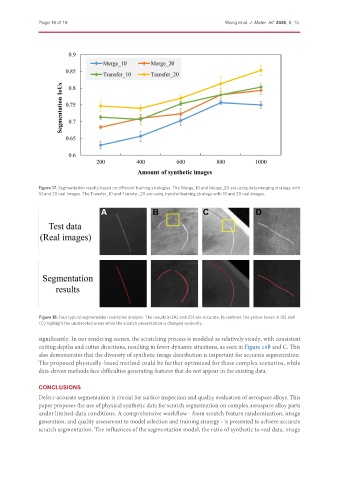
               Figure 17. Segmentation results based on different training strategies. The Merge_10 and Merge_20 are using data merging strategy with
               10 and 20 real images. The Transfer_10 and Transfer_20 are using transfer learning strategy with 10 and 20 real images.


               Figure 18. Four typical segmentation examples analysis. The results in (A) and (D) are accurate. In contrast, the yellow boxes in (B) and
               (C) highlight the undetected areas while the scratch presentation is changed evidently.

               significantly. In our rendering scenes, the scratching process is modeled as relatively steady, with consistent
               cutting depths and cutter directions, resulting in fewer dynamic situations, as seen in Figure 18B and C. This
               also demonstrates that the diversity of synthetic image distribution is important for accurate segmentation.
               The proposed physically-based method could be further optimized for these complex scenarios, while
               data-driven methods face difficulties generating features that do not appear in the existing data.


               CONCLUSIONS
               Defect-accurate segmentation is crucial for surface inspection and quality evaluation of aerospace alloys. This
               paper proposes the use of physical synthetic data for scratch segmentation on complex aerospace alloy parts
               under limited-data conditions. A comprehensive workflow - from scratch feature randomization, image
               generation, and quality assessment to model selection and training strategy - is presented to achieve accurate
               scratch segmentation. The influences of the segmentation model, the ratio of synthetic to real data, image

