


Page 64 - Read Online
P. 64
Tang et al. J. Mater. Inf. 2025, 5, 38  https://dx.doi.org/10.20517/jmi.2025.05  Page 5 of 19


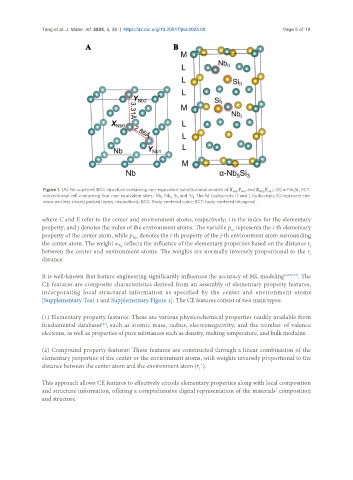
                Figure 1. (A) Nb supercell BCC structure containing non-equivalent substitutional models of X Nb0 Y  Nb1  and X  Nb0 Y Nb2 ; (B) α-Nb Si  BCT
                                                                                                    5
                                                                                                      3
                conventional cell containing four non-equivalent sites:  Nb , Nb , Si , and  Si . The M (subscripts I) and L (subscripts II) represent the
                                                          II
                                                                  II
                                                             I
                                                       I
                more and less closely packed layers, respectively. BCC: Body-centered cubic; BCT: body-centered tetragonal.
               where C and E refer to the center and environment atoms, respectively; i is the index for the elementary
               property, and j denotes the index of the environment atoms. The variable p  represents the i-th elementary
                                                                               c,i
               property of the center atom, while p  denotes the i-th property of the j-th environment atom surrounding
                                              E,j,i
               the center atom. The weight ω  reflects the influence of the elementary properties based on the distance r  j
                                         E,j
               between the center and environment atoms. The weights are normally inversely proportional to the r   j
               distance.
               It is well-known that feature engineering significantly influences the accuracy of ML modeling [2,3,30,42] . The
               CE features are composite characteristics derived from an assembly of elementary property features,
               incorporating  local  structural  information  as  specified  by  the  center  and  environment  atoms
               [Supplementary Text 1 and Supplementary Figure 1]. The CE features consist of two main types:


               (1) Elementary property features: These are various physicochemical properties readily available from
               fundamental databases , such as atomic mass, radius, electronegativity, and the number of valence
                                   [43]
               electrons, as well as properties of pure substances such as density, melting temperature, and bulk modulus.

               (2) Compound property features: These features are constructed through a linear combination of the
               elementary properties of the center or the environment atoms, with weights inversely proportional to the
               distance between the center atom and the environment atom (r ).
                                                                    -1
                                                                    j
               This approach allows CE features to effectively encode elementary properties along with local composition
               and structure information, offering a comprehensive digital representation of the materials’ composition
               and structure.

