


Page 51 - Read Online
P. 51
Page 8 of 20                         Zhu et al. J. Mater. Inf. 2025, 5, 8  https://dx.doi.org/10.20517/jmi.2024.76


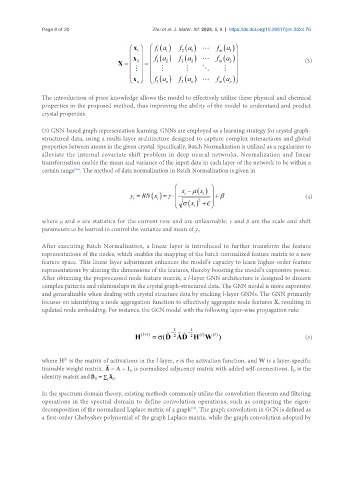
                                                                                                        (3)


               The introduction of prior knowledge allows the model to effectively utilize these physical and chemical
               properties in the proposed method, thus improving the ability of the model to understand and predict
               crystal properties.


               (3) GNN-based graph representation learning. GNNs are employed as a learning strategy for crystal graph-
               structured data, using a multi-layer architecture designed to capture complex interactions and global
               properties between atoms in the given crystal. Specifically, Batch Normalization is utilized as a regularizer to
               alleviate the internal covariate shift problem in deep neural networks. Normalization and linear
               transformation enable the mean and variance of the input data in each layer of the network to be within a
               certain range . The method of data normalization in Batch Normalization is given in
                          [36]


                                                                                                        (4)


               where μ and σ are statistics for the current row and are unlearnable. γ and β are the scale and shift
               parameters to be learned to control the variance and mean of y. i


               After executing Batch Normalization, a linear layer is introduced to further transform the feature
               representations of the nodes, which enables the mapping of the batch-normalized feature matrix to a new
               feature space. This linear layer adjustment enhances the model’s capacity to learn higher-order feature
               representations by altering the dimensions of the features, thereby boosting the model’s expressive power.
               After obtaining the preprocessed node feature matrix, a l-layer GNN architecture is designed to discern
               complex patterns and relationships in the crystal graph-structured data. The GNN model is more expressive
               and generalizable when dealing with crystal structure data by stacking l-layer GNNs. The GNN primarily
               focuses on identifying a node aggregation function to effectively aggregate node features X, resulting in
               updated node embedding. For instance, the GCN model with the following layer-wise propagation rule:


                                                                                                        (5)


               where H  is the matrix of activations in the l-layer, σ is the activation function, and W is a layer-specific
                       (l)
               trainable weight matrix. A = A + I  is normalized adjacency matrix with added self-connections. I  is the
                                             N
                                                                                                    N
               identity matrix and D  = ∑A .
                                       ij
                                 ii
                                     j
               In the spectrum domain theory, existing methods commonly utilize the convolution theorem and filtering
               operations in the spectral domain to define convolution operations, such as computing the eigen-
               decomposition of the normalized Laplace matrix of a graph . The graph convolution in GCN is defined as
                                                                 [19]
               a first-order Chebyshev polynomial of the graph Laplace matrix, while the graph convolution adopted by

