


Page 50 - Read Online
P. 50
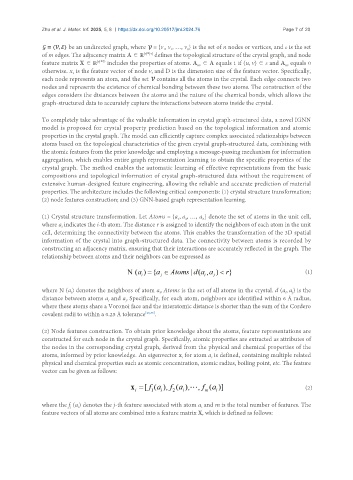
Zhu et al. J. Mater. Inf. 2025, 5, 8  https://dx.doi.org/10.20517/jmi.2024.76    Page 7 of 20

               G = (V, 3) be an undirected graph, where V = {v , v , …, v } is the set of n nodes or vertices, and ε is the set
                                                           2
                                                                n
                                                        1
               of m edges. The adjacency matrix A ∈ ℝ |v|×|v|  defines the topological structure of the crystal graph, and node
               feature matrix X ∈ ℝ |v|×D  includes the properties of atoms. A  ∈ A equals 1 if (u, v) ∈ ε and A  equals 0
                                                                    uv
                                                                                                 uv
               otherwise. x  is the feature vector of node v, and D is the dimension size of the feature vector. Specifically,
                         v
               each node represents an atom, and the set V contains all the atoms in the crystal. Each edge connects two
               nodes and represents the existence of chemical bonding between these two atoms. The construction of the
               edges considers the distances between the atoms and the nature of the chemical bonds, which allows the
               graph-structured data to accurately capture the interactions between atoms inside the crystal.
               To completely take advantage of the valuable information in crystal graph-structured data, a novel IGNN
               model is proposed for crystal property prediction based on the topological information and atomic
               properties in the crystal graph. The model can efficiently capture complex associated relationships between
               atoms based on the topological characteristics of the given crystal graph-structured data, combining with
               the atomic features from the prior knowledge and employing a message-passing mechanism for information
               aggregation, which enables entire graph representation learning to obtain the specific properties of the
               crystal graph. The method enables the automatic learning of effective representations from the basic
               compositions and topological information of crystal graph-structured data without the requirement of
               extensive human-designed feature engineering, allowing the reliable and accurate prediction of material
               properties. The architecture includes the following critical components: (1) crystal structure transformation;
               (2) node features construction; and (3) GNN-based graph representation learning.


               (1) Crystal structure transformation. Let Atoms = {a , a , …, a } denote the set of atoms in the unit cell,
                                                                2
                                                             1
                                                                     n
               where a indicates the i-th atom. The distance r is assigned to identify the neighbors of each atom in the unit
                      i
               cell, determining the connectivity between the atoms. This enables the transformation of the 3D spatial
               information of the crystal into graph-structured data. The connectivity between atoms is recorded by
               constructing an adjacency matrix, ensuring that their interactions are accurately reflected in the graph. The
               relationship between atoms and their neighbors can be expressed as
                                                                                                        (1)


               where N (a) denotes the neighbors of atom a, Atoms is the set of all atoms in the crystal. d (a, a) is the
                                                                                                    j
                                                       i
                                                                                                 i
                         i
               distance between atoms a and a. Specifically, for each atom, neighbors are identified within 6 Å radius,
                                           j
                                      i
               where these atoms share a Voronoi face and the interatomic distance is shorter than the sum of the Cordero
               covalent radii to within a 0.25 Å tolerance [20,35] .
               (2) Node features construction. To obtain prior knowledge about the atoms, feature representations are
               constructed for each node in the crystal graph. Specifically, atomic properties are extracted as attributes of
               the nodes in the corresponding crystal graph, derived from the physical and chemical properties of the
               atoms, informed by prior knowledge. An eigenvector x for atom a is defined, containing multiple related
                                                                        i
                                                              i
               physical and chemical properties such as atomic concentration, atomic radius, boiling point, etc. The feature
               vector can be given as follows:

                                                                                                        (2)

               where the f (a) denotes the j-th feature associated with atom a and m is the total number of features. The
                         j
                           i
                                                                     i
               feature vectors of all atoms are combined into a feature matrix X, which is defined as follows:

