


Page 49 - Read Online
P. 49
Page 6 of 20                         Zhu et al. J. Mater. Inf. 2025, 5, 8  https://dx.doi.org/10.20517/jmi.2024.76

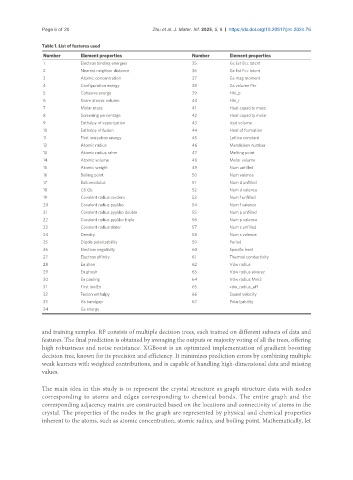
               Table 1. List of features used
                Number      Element properties                    Number      Element properties
                1           Electron binding energies             35          Gs Est Bcc latcnt
                2           Nearest neighbor distance             36          Gs Est Fcc latcnt
                3           Atomic concentration                  37          Gs mag moment
                4           Configuration energy                  38          Gs volume Per
                5           Cohesive energy                       39          Hhi_p
                6           Gram atomic volume                    40          Hhi_r
                7           Molar mass                            41          Heat capacity mass
                8           Screening percentage                  42          Heat capacity molar
                9           Enthalpy of vaporization              43          Icsd volume
                10          Enthalpy of fusion                    44          Heat of formation
                11          First ionization energy               45          Lattice constant
                12          Atomic radius                         46          Mendeleev number
                13          Atomic radius rahm                    47          Melting point
                14          Atomic volume                         48          Molar volume
                15          Atomic weight                         49          Num unfilled
                16          Boiling point                         50          Num valance
                17          Bulk modulus                          51          Num d unfilled
                18          C6 Gb                                 52          Num d valence
                19          Covalent radius cordero               53          Num f unfilled
                20          Covalent radius pyykko                54          Num f valence
                21          Covalent radius pyykko double         55          Num p unfilled
                22          Covalent radius pyykko triple         56          Num p valence
                23          Covalent radius slater                57          Num s unfilled
                24          Density                               58          Num s valence
                25          Dipole polarizability                 59          Period
                26          Electron negativity                   60          Specific heat
                27          Electron affinity                     61          Thermal conductivity
                28          En allen                              62          Vdw radius
                29          En ghosh                              63          Vdw radius alvarez
                30          En pauling                            64          Vdw radius Mm3
                31          First ion En                          65          vdw_radius_uff
                32          Fusion enthalpy                       66          Sound velocity
                33          Gs bandgap                            67          Polarizability
                34          Gs energy


               and training samples. RF consists of multiple decision trees, each trained on different subsets of data and
               features. The final prediction is obtained by averaging the outputs or majority voting of all the trees, offering
               high robustness and noise resistance. XGBoost is an optimized implementation of gradient boosting
               decision tree, known for its precision and efficiency. It minimizes prediction errors by combining multiple
               weak learners with weighted contributions, and is capable of handling high-dimensional data and missing
               values.


               The main idea in this study is to represent the crystal structure as graph structure data with nodes
               corresponding to atoms and edges corresponding to chemical bonds. The entire graph and the
               corresponding adjacency matrix are constructed based on the locations and connectivity of atoms in the
               crystal. The properties of the nodes in the graph are represented by physical and chemical properties
               inherent to the atoms, such as atomic concentration, atomic radius, and boiling point. Mathematically, let

