


Page 70 - Read Online
P. 70
Wen et al. J. Mater. Inf. 2025, 5, 30  https://dx.doi.org/10.20517/jmi.2024.102  Page 15 of 21


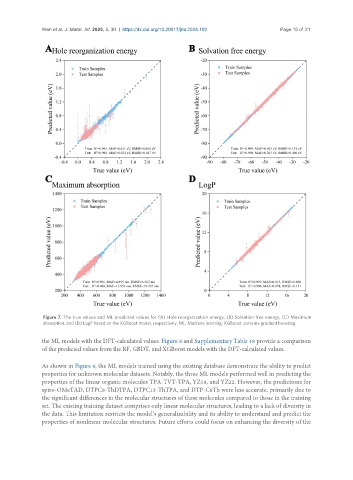
                Figure 7. The true values and ML predicted values for (A) Hole reorganization energy, (B) Solvation free energy, (C) Maximum
                absorption, and (D) LogP based on the XGBoost model, respectively. ML: Machine learning; XGBoost: extreme gradient boosting.

               the ML models with the DFT-calculated values. Figure 8 and Supplementary Table 18 provide a comparison
               of the predicted values from the RF, GBDT, and XGBoost models with the DFT-calculated values.

               As shown in Figure 8, the ML models trained using the existing database demonstrate the ability to predict
               properties for unknown molecular datasets. Notably, the three ML models performed well in predicting the
               properties of the linear organic molecules TPA-TVT-TPA, YZ18, and YZ22. However, the predictions for
               spiro-OMeTAD, DTPC8-ThDTPA, DTPC13-ThTPA, and DTP-C6Th were less accurate, primarily due to
               the significant differences in the molecular structures of these molecules compared to those in the training
               set. The existing training dataset comprises only linear molecular structures, leading to a lack of diversity in
               the data. This limitation restricts the model’s generalizability and its ability to understand and predict the
               properties of nonlinear molecular structures. Future efforts could focus on enhancing the diversity of the

