


Page 66 - Read Online
P. 66
Wen et al. J. Mater. Inf. 2025, 5, 30  https://dx.doi.org/10.20517/jmi.2024.102  Page 11 of 21


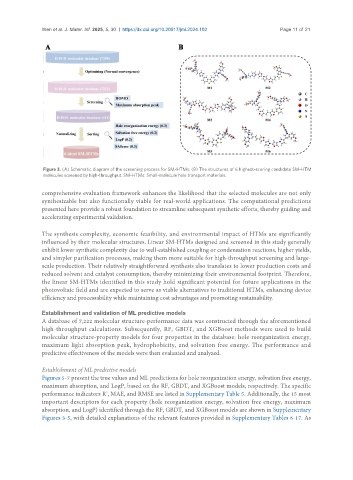
                Figure 3. (A) Schematic diagram of the screening process for SM-HTMs; (B) The structures of 6 highest-scoring candidate SM-HTM
                molecules screened by high-throughput. SM-HTMs: Small-molecule hole transport materials.


               comprehensive evaluation framework enhances the likelihood that the selected molecules are not only
               synthesizable but also functionally viable for real-world applications. The computational predictions
               presented here provide a robust foundation to streamline subsequent synthetic efforts, thereby guiding and
               accelerating experimental validation.

               The synthesis complexity, economic feasibility, and environmental impact of HTMs are significantly
               influenced by their molecular structures. Linear SM-HTMs designed and screened in this study generally
               exhibit lower synthetic complexity due to well-established coupling or condensation reactions, higher yields,
               and simpler purification processes, making them more suitable for high-throughput screening and large-
               scale production. Their relatively straightforward synthesis also translates to lower production costs and
               reduced solvent and catalyst consumption, thereby minimizing their environmental footprint. Therefore,
               the linear SM-HTMs identified in this study hold significant potential for future applications in the
               photovoltaic field and are expected to serve as viable alternatives to traditional HTMs, enhancing device
               efficiency and processability while maintaining cost advantages and promoting sustainability.

               Establishment and validation of ML predictive models
               A database of 7,222 molecular structure-performance data was constructed through the aforementioned
               high-throughput calculations. Subsequently, RF, GBDT, and XGBoost methods were used to build
               molecular structure-property models for four properties in the database: hole reorganization energy,
               maximum light absorption peak, hydrophobicity, and solvation free energy. The performance and
               predictive effectiveness of the models were then evaluated and analyzed.

               Establishment of ML predictive models
               Figures 5-7 present the true values and ML predictions for hole reorganization energy, solvation free energy,
               maximum absorption, and LogP, based on the RF, GBDT, and XGBoost models, respectively. The specific
               performance indicators R , MAE, and RMSE are listed in Supplementary Table 5. Additionally, the 15 most
                                     2
               important descriptors for each property (hole reorganization energy, solvation free energy, maximum
               absorption, and LogP) identified through the RF, GBDT, and XGBoost models are shown in Supplementary
               Figures 3-5, with detailed explanations of the relevant features provided in Supplementary Tables 6-17. As

