


Page 61 - Read Online
P. 61
Page 6 of 21                       Wen et al. J. Mater. Inf. 2025, 5, 30  https://dx.doi.org/10.20517/jmi.2024.102


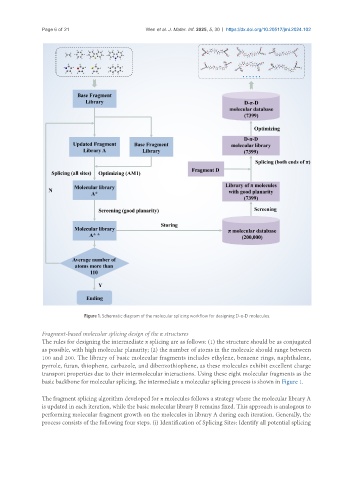
                             Figure 1. Schematic diagram of the molecular splicing workflow for designing D-π-D molecules.

               Fragment-based molecular splicing design of the π structures
               The rules for designing the intermediate π splicing are as follows: (1) the structure should be as conjugated
               as possible, with high molecular planarity; (2) the number of atoms in the molecule should range between
               100 and 200. The library of basic molecular fragments includes ethylene, benzene rings, naphthalene,
               pyrrole, furan, thiophene, carbazole, and dibenzothiophene, as these molecules exhibit excellent charge
               transport properties due to their intermolecular interactions. Using these eight molecular fragments as the
               basic backbone for molecular splicing, the intermediate π molecular splicing process is shown in Figure 1.

               The fragment splicing algorithm developed for π molecules follows a strategy where the molecular library A
               is updated in each iteration, while the basic molecular library B remains fixed. This approach is analogous to
               performing molecular fragment growth on the molecules in library A during each iteration. Generally, the
               process consists of the following four steps. (i) Identification of Splicing Sites: Identify all potential splicing

