


Page 59 - Read Online
P. 59
Page 4 of 21                       Wen et al. J. Mater. Inf. 2025, 5, 30  https://dx.doi.org/10.20517/jmi.2024.102

               gradient boosted decision trees (GBDTs), and extreme gradient boosting (XGBoost). The results indicate
               that the model built with the XGBoost algorithm not only requires the least training time but also delivers
               the best prediction accuracy, demonstrating the most comprehensive performance. This work will offer a
               rapid, efficient and cost-effective approach for the development of new SM-HTMs by combining MSA with
               high-throughput computational screening and ML.


               MATERIALS AND METHODS
               First principle calculation
                                                                        [42]
               All DFT calculations were conducted using Gaussian 16 software . Initial optimization was carried out
                                                                               [43]
               using the semi-empirical AM1 method during the molecular splicing stage . Under gas-phase conditions,
               geometry optimization, HOMO energy levels, hole reorganization energy, and absorption spectra were
               calculated at the B3LYP level with the 6-31++G(d,p) basis set . Furthermore, the solvation free energy of
                                                                    [44]
               the solvent molecules in n-octanol and water was calculated using the M062X functional and the
               6-31++G(d,p) basis set to estimate the hydrophobicity (LogP) [45,46] .


               Based on the optimized structure, the HOMO level, hole reorganization energy, solvation free energy,
               maximum light absorption wavelength, hydrophobicity, and synthetic feasibility score (SAScore) of the
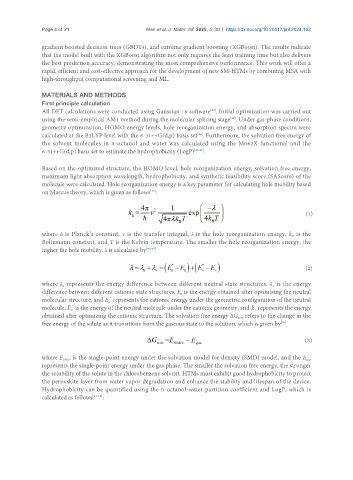
               molecule were calculated. Hole reorganization energy is a key parameter for calculating hole mobility based
               on Marcus theory, which is given as follows :
                                                    [47]

                                                                                                        (1)


               where ħ is Planck’s constant, v is the transfer integral, λ is the hole reorganization energy, k  is the
                                                                                                   B
               Boltzmann constant, and T is the Kelvin temperature. The smaller the hole reorganization energy, the
               higher the hole mobility. λ is calculated by [48,49]


                                                                                                        (2)

               where λ  represents the energy difference between different neutral state structures, λ  is the energy
                      0
                                                                                             +
               difference between different cationic state structures, E  is the energy obtained after optimizing the neutral
                                                              0
                                      *
               molecular structure, and E  represents the cationic energy under the geometric configuration of the neutral
                                      +
               molecule. E  is the energy of the neutral molecule under the cationic geometry, and E  represents the energy
                         *
                                                                                       +
                         0
               obtained after optimizing the cationic structure. The solvation free energy ΔG  refers to the change in the
                                                                                 solv
               free energy of the solute as it transitions from the gaseous state to the solution, which is given by [50]
                                                                                                        (3)
               where E SMD  is the single-point energy under the solvation model for density (SMD) model, and the E
                                                                                                        gas
               represents the single-point energy under the gas phase. The smaller the solvation free energy, the stronger
               the solubility of the solute in the chlorobenzene solvent. HTMs must exhibit good hydrophobicity to protect
               the perovskite layer from water vapor degradation and enhance the stability and lifespan of the device.
               Hydrophobicity can be quantified using the n-octanol-water partition coefficient and LogP, which is
               calculated as follows [51-53] :

