


Page 100 - Read Online
P. 100
Page 24 of 31                       Shu et al. J. Mater. Inf. 2025, 5, 36  https://dx.doi.org/10.20517/jmi.2025.13

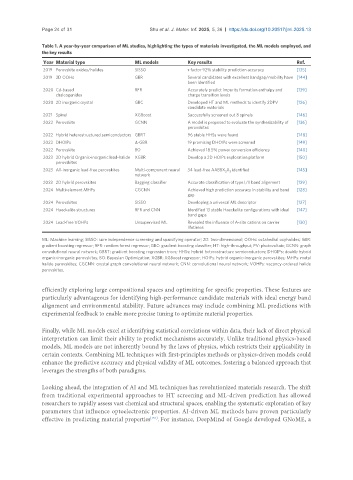
               Table 1. A year-by-year comparison of ML studies, highlighting the types of materials investigated, the ML models employed, and
               the key results
                Year Material type            ML models         Key results                          Ref.
                2019 Perovskite oxides/halides  SISSO           τ factor 92% stability prediction accuracy  [135]
                2019 2D OOHs                  GBR               Several candidates with excellent bandgap/mobility have [144]
                                                                been identified
                2020 Cd-based                 RFR               Accurately predict impurity formation enthalpy and   [139]
                    chalcogenides                               charge transition levels
                2020 2D inorganic crystal     GBC               Developed HT and ML methods to identify 2DPV   [126]
                                                                candidate materials
                2021 Spinel                   XGBoost           Successfully screened out 8 spinels  [146]
                2022 Perovskite               GCNN              A model is proposed to evaluate the synthesizability of   [136]
                                                                perovskites
                2022 Hybrid heterostructured semiconductors GBRT  96 stable HHSs were found          [148]
                2022 DHOIPs                   Δ-GBR             19 promising DHOIPs were screened    [149]
                2022 Perovskite               BO                Achieved 18.5% power conversion efficiency  [140]
                2023 2D hybrid Organic-inorganic lead-halide  XGBR  Develop a 2D HOIPs exploration platform  [150]
                    perovskites
                2023 All-inorganic lead-free perovskites  Multi-component neural   34 lead-free AABBX X  identified  [145]
                                                                             3 3
                                              network
                2023 2D hybrid perovskites    Bagging classifier  Accurate classification of type I/II band alignment  [129]
                2024 Multi-element MHPs       CGCNN             Achieved high prediction accuracy in stability and band   [128]
                                                                gap
                2024 Perovskites              SISSO             Developing a universal ML descriptor  [127]
                2024 Haeckelite structures    RFR and CNN       Identified 13 stable Haeckelite configurations with ideal   [147]
                                                                band gaps
                2024 Lead-free VOHPs          Unsupervised ML   Revealed the influence of A-site cations on carrier   [130]
                                                                lifetimes
               ML: Machine learning; SISSO: sure independence screening and sparsifying operator; 2D: two-dimensional; OOHs: octahedral oxyhalides; GBR:
               gradient boosting regressor; RFR: random forest regressor; GBC: gradient boosting classifier; HT: high-throughput; PV: photovoltaic; GCNN: graph
               convolutional neural network; GBRT: gradient boosting regression trees; HHSs: hybrid heterostructure semiconductors; DHOIPs: double hybrid
               organic-inorganic perovskites; BO: Bayesian Optimization; XGBR: XGBoost regressor; HOIPs: hybrid organic-inorganic perovskites; MHPs: metal
               halide perovskites; CGCNN: crystal graph convolutional neural network; CNN: convolutional neural network; VOHPs: vacancy-ordered halide
               perovskites.


               efficiently exploring large compositional spaces and optimizing for specific properties. These features are
               particularly advantageous for identifying high-performance candidate materials with ideal energy band
               alignment and environmental stability. Future advances may include combining ML predictions with
               experimental feedback to enable more precise tuning to optimize material properties.


               Finally, while ML models excel at identifying statistical correlations within data, their lack of direct physical
               interpretation can limit their ability to predict mechanisms accurately. Unlike traditional physics-based
               models, ML models are not inherently bound by the laws of physics, which restricts their applicability in
               certain contexts. Combining ML techniques with first-principles methods or physics-driven models could
               enhance the predictive accuracy and physical validity of ML outcomes, fostering a balanced approach that
               leverages the strengths of both paradigms.


               Looking ahead, the integration of AI and ML techniques has revolutionized materials research. The shift
               from traditional experimental approaches to HT screening and ML-driven prediction has allowed
               researchers to rapidly assess vast chemical and structural spaces, enabling the systematic exploration of key
               parameters that influence optoelectronic properties. AI-driven ML methods have proven particularly
               effective in predicting material properties . For instance, DeepMind of Google developed GNoME, a
                                                    [151]

