


Page 99 - Read Online
P. 99
Shu et al. J. Mater. Inf. 2025, 5, 36  https://dx.doi.org/10.20517/jmi.2025.13  Page 23 of 31


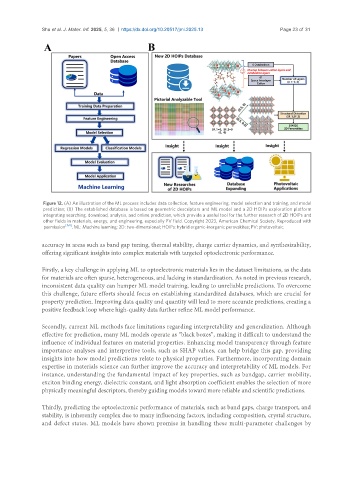
                Figure 12. (A) An illustration of the ML process includes data collection, feature engineering, model selection and training, and model
                prediction; (B) The established database is based on geometric descriptors and ML model and a 2D HOIPs exploration platform
                integrating searching, download, analysis, and online prediction, which provide a useful tool for the further research of 2D HOIPs and
                other fields in materials, energy, and engineering, especially PV field. Copyright 2023, American Chemical Society, Reproduced with
                permission [150] . ML: Machine learning; 2D: two-dimensional; HOIPs: hybrid organic-inorganic perovskites; PV: photovoltaic.


               accuracy in areas such as band gap tuning, thermal stability, charge carrier dynamics, and synthesizability,
               offering significant insights into complex materials with targeted optoelectronic performance.


               Firstly, a key challenge in applying ML to optoelectronic materials lies in the dataset limitations, as the data
               for materials are often sparse, heterogeneous, and lacking in standardization. As noted in previous research,
               inconsistent data quality can hamper ML model training, leading to unreliable predictions. To overcome
               this challenge, future efforts should focus on establishing standardized databases, which are crucial for
               property prediction. Improving data quality and quantity will lead to more accurate predictions, creating a
               positive feedback loop where high-quality data further refine ML model performance.


               Secondly, current ML methods face limitations regarding interpretability and generalization. Although
               effective for prediction, many ML models operate as “black boxes”, making it difficult to understand the
               influence of individual features on material properties. Enhancing model transparency through feature
               importance analyses and interpretive tools, such as SHAP values, can help bridge this gap, providing
               insights into how model predictions relate to physical properties. Furthermore, incorporating domain
               expertise in materials science can further improve the accuracy and interpretability of ML models. For
               instance, understanding the fundamental impact of key properties, such as bandgap, carrier mobility,
               exciton binding energy, dielectric constant, and light absorption coefficient enables the selection of more
               physically meaningful descriptors, thereby guiding models toward more reliable and scientific predictions.


               Thirdly, predicting the optoelectronic performance of materials, such as band gaps, charge transport, and
               stability, is inherently complex due to many influencing factors, including composition, crystal structure,
               and defect states. ML models have shown promise in handling these multi-parameter challenges by

