


Page 92 - Read Online
P. 92
Page 8 of 12                         Chi et al. J. Mater. Inf. 2025, 5, 11  https://dx.doi.org/10.20517/jmi.2024.49


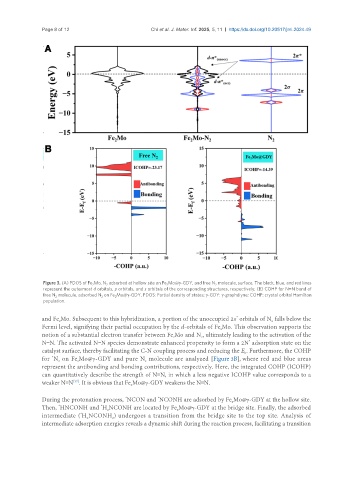
                Figure 3. (A) PDOS of Fe Mo, N  adsorbed at hollow site on Fe Mo@γ-GDY, and free N  molecule, surface. The black, blue, and red lines
                                     2
                                                         2
                                                                          2
                                2
                represent the outermost d orbitals, p orbitals, and s orbitals of the corresponding structures, respectively; (B) COHP for N≡N bond of
                free N  molecule, adsorbed N  on Fe Mo@γ-GDY. PDOS: Partial density of states; γ-GDY: γ-graphdiyne; COHP: crystal orbital Hamilton
                    2
                                   2
                                        2
                population.
               and Fe Mo. Subsequent to this hybridization, a portion of the unoccupied 2π  orbitals of N  falls below the
                                                                                 *
                                                                                             2
                     2
               Fermi level, signifying their partial occupation by the d-orbitals of Fe Mo. This observation supports the
                                                                           2
               notion of a substantial electron transfer between Fe Mo and N , ultimately leading to the activation of the
                                                           2
                                                                     2
               N≡N. The activated N≡N species demonstrate enhanced propensity to form a 2N  adsorption state on the
                                                                                     *
               catalyst surface, thereby facilitating the C-N coupling process and reducing the E . Furthermore, the COHP
                                                                                   b
               for  N  on Fe Mo@γ-GDY and pure N  molecule are analyzed [Figure 3B], where red and blue areas
                   *
                                                  2
                           2
                     2
               represent the antibonding and bonding contributions, respectively. Here, the integrated COHP (ICOHP)
               can quantitatively describe the strength of N≡N, in which a less negative ICOHP value corresponds to a
                          [37]
               weaker N≡N . It is obvious that Fe Mo@γ-GDY weakens the N≡N.
                                             2
                                                      *
               During the protonation process,  NCON and  NCONH are adsorbed by Fe Mo@γ-GDY at the hollow site.
                                           *
                                                                               2
               Then,  HNCONH and  H NCONH are located by Fe Mo@γ-GDY at the bridge site. Finally, the adsorbed
                     *
                                   *
                                     2
                                                             2
               intermediate ( H NCONH ) undergoes a transition from the bridge site to the top site. Analysis of
                            *
                              2
                                       2
               intermediate adsorption energies reveals a dynamic shift during the reaction process, facilitating a transition

