


Page 90 - Read Online
P. 90
Page 6 of 12                         Chi et al. J. Mater. Inf. 2025, 5, 11  https://dx.doi.org/10.20517/jmi.2024.49

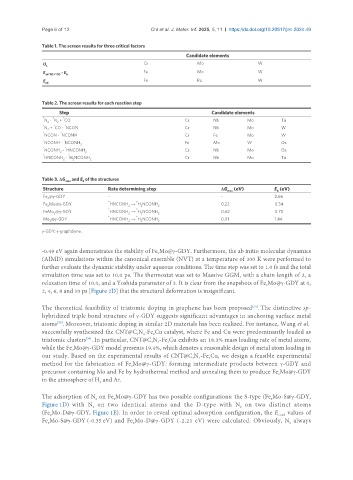
               Table 1. The screen results for three critical factors
                                                                Candidate elements
                U L                              Cr                 Mo                  W
                E ad*N2+*CO  - E b               Fe                 Mo                  W
                E ad                             Fe                 Ru                  W


               Table 2. The screen results for each reaction step
                     Step                                               Candidate elements
                *  *  *
                N  -  N  +  CO                                 Cr        Nb         Mo          Ta
                    2
                 2
                *  *   *
                N  +  CO -  NCON                               Cr        Nb         Mo          W
                 2
                *    *
                NCON -  NCONH                                  Cr        Fe         Mo          W
                *     *
                NCONH -  NCONH                                 Fe        Mo         W           Os
                            2
                *      *
                NCONH  -  HNCONH 2                             Cr        Nb         Mo          Os
                     2
                *       *
                HNCONH  -  H NCONH 2                           Cr        Nb         Mo          Ta
                      2
                          2
               Table 3. ΔG max  and E  of the structures
                             b
                Structure            Rate determining step                 ΔG max  (eV)       E  (eV)
                                                                                              b
                Fe @γ-GDY             -                                     -                 2.66
                 3
                                               *
                Fe Mo@γ-GDY           * HNCONH  →  H NCONH 2                0.22              0.34
                                                2
                                            2
                 2
                                      *        *
                FeMo @γ-GDY           HNCONH  →  H NCONH                    0.62              0.70
                   2                        2   2     2
                                      *        *
                Mo @γ-GDY             HNCONH  →  H NCONH 2                  0.91              1.44
                  3
                                                2
                                            2
               γ-GDY: γ-graphdiyne.
               -0.49 eV again demonstrates the stability of Fe Mo@γ-GDY. Furthermore, the ab initio molecular dynamics
                                                      2
               (AIMD) simulations within the canonical ensemble (NVT) at a temperature of 300 K were performed to
               further evaluate the dynamic stability under aqueous conditions. The time step was set to 1.0 fs and the total
               simulation time was set to 10.0 ps. The thermostat was set to Massive GGM, with a chain length of 2, a
               relaxation time of 10.0, and a Yoshida parameter of 3. It is clear from the snapshots of Fe Mo@γ-GDY at 0,
                                                                                           2
               2, 4, 6, 8 and 10 ps [Figure 2D] that the structural deformation is insignificant.
                                                                                      [34]
               The theoretical feasibility of triatomic doping in graphene has been proposed . The distinctive sp-
               hybridized triple bond structure of γ-GDY suggests significant advantages in anchoring surface metal
               atoms . Moreover, triatomic doping in similar 2D materials has been realized. For instance, Wang et al.
                    [35]
               successfully synthesized the CNT@C N -Fe Cu catalyst, where Fe and Cu were predominantly loaded as
                                                     2
                                                 4
                                               3
               triatomic clusters . In particular, CNT@C N -Fe Cu exhibits an 18.3% mass loading rate of metal atoms,
                              [36]
                                                    3
                                                         2
                                                      4
               while the Fe Mo@γ-GDY model presents 19.4%, which denotes a reasonable design of metal atom loading in
                         2
               our study. Based on the experimental results of CNT@C N -Fe Cu, we design a feasible experimental
                                                                  3
                                                                    4
                                                                       2
               method for the fabrication of Fe Mo@γ-GDY: forming intermediate products between  γ-GDY and
                                             2
               precursor containing Mo and Fe by hydrothermal method and annealing them to produce Fe Mo@γ-GDY
                                                                                               2
               in the atmosphere of H  and Ar.
                                   2
               The adsorption of N  on Fe Mo@γ-GDY has two possible configurations: the S-type (Fe Mo-S@γ-GDY,
                                                                                            2
                                       2
                                 2
               Figure 1D)  with  N   on  two  identical  atoms  and  the  D-type  with  N   on  two  distinct  atoms
                                                                                  2
                                2
               (Fe Mo-D@γ-GDY, Figure 1E). In order to reveal optimal adsorption configuration, the E  values of
                                                                                               coad
                  2
               Fe Mo-S@γ-GDY (-0.35 eV) and Fe Mo-D@γ-GDY (-2.21 eV) were calculated. Obviously, N  always
                                                                                                   2
                                              2
                 2

