


Page 87 - Read Online
P. 87
Chi et al. J. Mater. Inf. 2025, 5, 11  https://dx.doi.org/10.20517/jmi.2024.49   Page 3 of 12


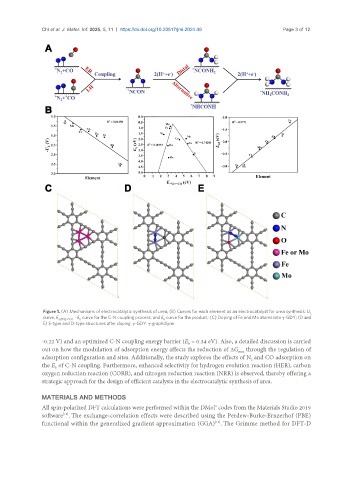
                Figure 1. (A) Mechanisms of electrocatalytic synthesis of urea; (B) Curves for each element as an electrocatalyst for urea synthesis: U   L
                curve, E ad*N2+*CO  - E  curve for the C-N coupling process, and E  curve for the product; (C) Doping of Fe and Mo atoms into γ-GDY; (D and
                            b
                                                        b
                E) S-type and D-type structures after doping. γ-GDY: γ-graphdiyne.
               -0.22 V) and an optimized C-N coupling energy barrier (E  = 0.34 eV). Also, a detailed discussion is carried
                                                                b
               out on how the modulation of adsorption energy affects the reduction of ΔG  through the regulation of
                                                                                 max
               adsorption configuration and sites. Additionally, the study explores the effects of N  and CO adsorption on
                                                                                      2
               the E  of C-N coupling. Furthermore, enhanced selectivity for hydrogen evolution reaction (HER), carbon
                    b
               oxygen reduction reaction (CORR), and nitrogen reduction reaction (NRR) is observed, thereby offering a
               strategic approach for the design of efficient catalysts in the electrocatalytic synthesis of urea.

               MATERIALS AND METHODS
               All spin-polarized DFT calculations were performed within the DMol  codes from the Materials Studio 2019
                                                                          3
               software . The exchange-correlation effects were described using the Perdew-Burke-Ernzerhof (PBE)
                      [18]
               functional within the generalized gradient approximation (GGA) . The Grimme method for DFT-D
                                                                         [19]

