


Page 9 - Read Online
P. 9
Han et al. J Mater Inf 2023;3:24  https://dx.doi.org/10.20517/jmi.2023.32        Page 3 of 11

               a single atom (M ) and a bimetallic atom (M ) site. In this work, we replaced the precious metal Ag atoms in
                             1
                                                    2
               Ag @C  with Mo/Fe atoms and obtained the Mo /Fe @C  monolayer. Through theoretical studies of the
                     20
                  3
                                                          3
                                                             3
                                                                20
               eNRR process, we found that Mo @C  is not suitable for eNRR due to its strong N  adsorption; in contrast,
                                           3
                                                                                     2
                                               20
               Fe @C  is a good eNRR catalyst (the limiting potential U  = -0.59 V). With the demonstration that Fe @C
                                                                                                         20
                                                                L
                     20
                 3
                                                                                                     3
               can be used as an electrocatalyst for eNRR, we substituted the C bonded with Fe by N to tune the
               coordination environment of the metal sites in order to further improve the catalytic efficiency. The limiting
               potential was further changed to -0.45 V when the N doping of the Fe  site was the maximum; i.e., all the
                                                                            2
               four C bonded with Fe  sites were replaced by N with the stoichiometry of Fe @N C .
                                                                                   4 16
                                  2
                                                                                3
               MATERIALS AND METHODS
               All density functional theory (DFT) calculations were carried out using the Vienna ab initio Simulation
               Package (VASP) . The Perdew, Burke, and Ernzerhof (PBE)  parameterization of the generalized
                                                                       [48]
                              [47]
               gradient approximation (GGA) was used to describe the exchange-correlation function. The DFT-D2
               dispersion correction scheme was applied for van der Waals (vdW) interactions . A cut-off energy of
                                                                                      [49]
               600 eV was used (convergence tests are shown in Supplementary Figure 1). The convergence parameters for
                                                  -5
               force and energy were 0.02 eV/Å and 10  eV, respectively, and the convergence parameters were set the
               same as those in previous NRR calculations . The Brillouin zone was sampled using a Monkhorst-Pack k-
                                                    [50]
               point grid  of 3 × 5 × 1. The Bader charge analysis  was employed to evaluate the charge transfer.
                        [51]
                                                          [52]
               The adsorption energy of N  was calculated by E  = E  - E  - E , where E , E , and E  are the total energy
                                       2
                                                                                        N2
                                                                              tot
                                                                 *
                                                                     N2
                                                             tot
                                                        ads
                                                                                 *
               of N  adsorbed on the catalyst, the clean catalyst, and free N , respectively. The free energy G was obtained
                                                                  2
                   2
               based on the computational hydrogen electrode (CHE) model proposed by Nørskov et al. , with the
                                                                                                [53]
               formula:
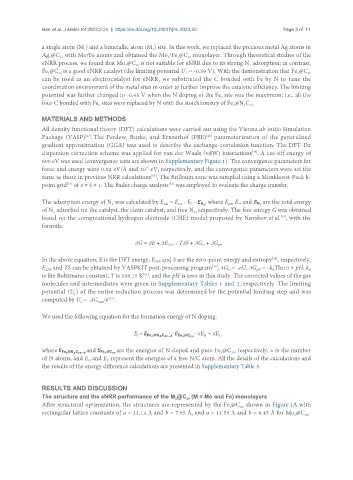
                                               ΔG = ΔE + ΔE  - TΔS + ΔG  + ΔG pH
                                                                     U
                                                          ZPE
                                                                                             [54]
               In the above equation, E is the DFT energy, E  and S are the zero-point energy and entropy , respectively,
                                                     ZPE
               E  and TS can be obtained by VASPKIT post-processing program , ΔG  = -eU, ΔG  = -k Tln10 × pH, k
                                                                         [55]
                                                                                                         B
                                                                              U
                                                                                             B
                ZPE
                                                                                       pH
               is the Boltzmann constant, T is 298.15 K , and the pH is zero in this study. The corrected values of the gas
                                                 [56]
               molecules and intermediates were given in Supplementary Tables 1 and 2, respectively. The limiting
               potential (U ) of the entire reduction process was determined by the potential limiting step and was
                          L
               computed by U  = -ΔG /e .
                                     [57]
                                  max
                            L
               We used the following equation for the formation energy of N doping:
                                              E = E Fe3@NxC20-x    - E Fe3@C20  - xE  + xE C
                                                                      N
                                               f
               where E Fe3@NxC20-x   and E Fe3@C20  are the energies of N-doped and pure Fe @C , respectively, x is the number
                                                                           3
                                                                               20
               of N atoms, and E  and E  represent the energies of a free N/C atom. All the details of the calculations and
                                     C
                               N
               the results of the energy difference calculations are presented in Supplementary Table 3.
               RESULTS AND DISCUSSION
               The structure and the eNRR performance of the M @C  (M = Mo and Fe) monolayers
                                                                20
                                                            3
               After structural optimization, the structures are represented by the Fe @C  shown in Figure 1A with
                                                                              3
                                                                                  20
               rectangular lattice constants of a = 11.14 Å and b = 7.95 Å, and a = 11.59 Å and b = 8.45 Å for Mo @C ,
                                                                                                    3
                                                                                                        20

