Page 14 - Read Online
P. 14

Page 8 of 11                           Han et al. J Mater Inf 2023;3:24  https://dx.doi.org/10.20517/jmi.2023.32


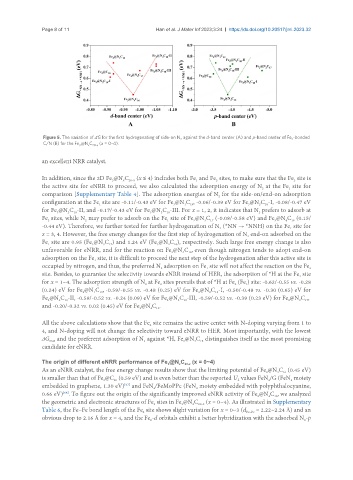
                Figure 5. The variation of ΔG for the first hydrogenating of side-on N  against the d-band center (A) and p-band center of Fe -bonded
                                                              2
                                                                                                   2
                C/N (B) for the Fe @N C 20-x  (x = 0~4).
                               x
                            3
               an excellent NRR catalyst.

               In addition, since the 2D Fe @N C  (x ≤ 4) includes both Fe  and Fe  sites, to make sure that the Fe  site is
                                                                          2
                                                                                                    2
                                       3
                                            20-x
                                          x
                                                                   1
               the active site for eNRR to proceed, we also calculated the adsorption energy of N  at the Fe  site for
                                                                                         2
                                                                                                  1
               comparison [Supplementary Table 4]. The adsorption energies of N  for the side-on/end-on adsorption
                                                                           2
               configuration at the Fe  site are -0.11/-0.43 eV for Fe @N C , -0.06/-0.39 eV for Fe @N C -I, -0.08/-0.47 eV
                                                                                     3
                                  1
                                                           3
                                                                                          18
                                                                 19
                                                               1
                                                                                        2
               for Fe @N C -II, and -0.17/-0.43 eV for Fe @N C -III. For x = 1, 2, it indicates that N  prefers to adsorb at
                        2
                          18
                    3
                                                    3
                                                                                        2
                                                         18
                                                       2
               Fe  sites, while N  may prefer to adsorb on the Fe  site of Fe @N C  (-0.08/-0.58 eV) and Fe @N C  (0.15/
                                                                        17
                              2
                                                                  3
                                                                                                 4
                 2
                                                                                              3
                                                         1
                                                                      3
                                                                                                   16
               -0.44 eV). Therefore, we further tested for further hydrogenation of N  (*NN → *NNH) on the Fe  site for
                                                                           2
                                                                                                   1
               x = 3, 4. However, the free energy changes for the first step of hydrogenation of N  end-on adsorbed on the
                                                                                    2
               Fe  site are 0.95 (Fe @N C ) and 1.24 eV (Fe @N C ), respectively. Such large free energy change is also
                                                            16
                                                          4
                                                      3
                 1
                                3
                                      17
                                    3
               unfavorable for eNRR, and for the reaction on Fe @N C , even though nitrogen tends to adopt end-on
                                                           3
                                                                 16
                                                               4
               adsorption on the Fe  site, it is difficult to proceed the next step of the hydrogenation after this active site is
                                 1
               occupied by nitrogen, and thus, the preferred N  adsorption on Fe  site will not affect the reaction on the Fe
                                                       2
                                                                                                         2
                                                                       1
               site. Besides, to guarantee the selectivity towards eNRR instead of HER, the adsorption of *H at the Fe  site
                                                                                                      1
               for x = 1~4. The adsorption strength of N  at Fe  sites prevails that of *H at Fe  (Fe ) site: -0.62/-0.55 vs. -0.28
                                                                                    1
                                                                                2
                                                  2
                                                       2
               (0.24) eV for Fe @N C , -0.59/-0.55 vs. -0.48 (0.25) eV for Fe @N C -I, -0.50/-0.48 vs. -0.30 (0.65) eV for
                                 1
                                   19
                                                                         18
                             3
                                                                    3
                                                                        2
               Fe @N C -II, -0.59/-0.52 vs. -0.24 (0.09) eV for Fe @N C -III, -0.59/-0.52 vs. -0.39 (0.23 eV) for Fe @N C ,
                                                                                                  3
                                                               18
                                                                                                      3
                 3
                     2 18
                                                         3
                                                             2
                                                                                                        17
               and -0.20/-0.32 vs. 0.02 (0.45) eV for Fe @N C .
                                                    4 16
                                                3
               All the above calculations show that the Fe  site remains the active center with N-doping varying from 1 to
                                                    2
               4, and N-doping will not change the selectivity toward eNRR to HER. Most importantly, with the lowest
               ΔG  and the preferent adsorption of N  against *H, Fe @N C  distinguishes itself as the most promising
                                                                   4
                  max
                                                 2
                                                                    16
                                                               3
               candidate for eNRR.
               The origin of different eNRR performance of Fe @N C   (x = 0~4)
                                                          3  x  20-x
               As an eNRR catalyst, the free energy change results show that the limiting potential of Fe @N C  (0.45 eV)
                                                                                              4
                                                                                                16
                                                                                           3
               is smaller than that of Fe @C  (0.59 eV) and is even better than the reported U  values FeN /G (FeN  moiety
                                                                                           4
                                       20
                                                                                                   4
                                    3
                                                                                 L
               embedded in graphene, 1.30 eV)  and FeN /FeMoPPc (FeN  moiety embedded with polyphthalocyanine,
                                           [63]
                                                                   4
                                                     4
               0.66 eV) . To figure out the origin of the significantly improved eNRR activity of Fe @N C , we analyzed
                      [64]
                                                                                             16
                                                                                            4
                                                                                        3
               the geometric and electronic structures of Fe  sites in Fe @N C  (x = 0~4). As illustrated in Supplementary
                                                                    20-x
                                                              3
                                                                  x
                                                     2
               Table 6, the Fe−Fe bond length of the Fe  site shows slight variation for x = 0~3 (d Fe−Fe  = 2.22~2.24 Å) and an
                                                 2
               obvious drop to 2.16 Å for x = 4, and the Fe -d orbitals exhibit a better hybridization with the adsorbed N -p
                                                    2
                                                                                                        2
   9   10   11   12   13   14   15   16   17   18   19